
One of the world’s most renowned architects, Bjarke Ingels merges futurism, sustainability and a bit of humour into his massive projects, quite literally shaping the landscape of tomorrow. Yet, his sweet summer escape is rooted firmly in the past. For our first Vogue Scandinavia Living cover, we travel to Rørvig to step inside the Danish architect’s charming summerhouse
“I had sworn that I would never have a summerhouse,” says Bjarke Ingels.
It wasn’t that the renowned Danish architect had a bad experience with summerhouses, or that he inherently disliked the idea of having one. “When I was a kid, we would always go on trips during the summer, but then when my parents bought a summerhouse, we never went on trips again – we always just went to the summerhouse,” he recalls. “I kind of liked it, for sure – it was in the middle of the forest in Sweden. But ironically, my childhood home, where my parents still live, is by a lake in a forest in Denmark, right next to the beach. I like to joke that my family was the only one who bought a summerhouse with less wonderful nature than the place they actually live in.”
So, what changed his mind? “My son turned two, and it became quite important for me that he would feel rooted in Denmark,” Ingels says. “I think that once you have children, the microcosmos of the summerhouse becomes incredibly lovely. And I travel so much for work that for me, a holiday is actually to not travel.”
Related: Tour Alexandra Hoang's newly-renovated 'Japandi' Oslo home – and shop her favourite interior picks
I catch the visionary creative in one of those rare, cherished moments of non-travel in his birthplace and part-time home, Copenhagen (he splits his time between the Danish capital and New York). His dwelling in the city is not your regular abode, as one might expect from Ingels. Sitting on the harbour’s edge and overlooking the majestic CopenHill – a cutting-edge, Bjarke Ingels Group-designed waste-to-energy power plant topped with a ski slope – the place isn’t a house in the traditional sense, but a decommissioned ferryboat transformed into a sleek, floating family home. As we chat, Ingels, 50, dressed in a crisp white shirt, treats me to virtual glimpses of the space and its surroundings, my screen awash with golden Copenhagen sunshine.
/Bjarke_Ingels_Vogue_Scandinavia_2025_CMA_9_C9_A1650_Web_8ebee0c302/Bjarke_Ingels_Vogue_Scandinavia_2025_CMA_9_C9_A1650_Web_8ebee0c302.jpg)
Bjarke Ingels in his summerhouse in Rørvig. Dating back to 1918, the home appears straight out of a Hans Christian Andersen fairy tale – a far cry from the large scale projects that have made him one of the most famous architects in the world. Sockets, Switches. Both Katy Paty. Custom built-in sofa with storage. Beier Davidsen. Cushions. Kvadrat. Bjarke wears Blazer, €520. Another Aspect via Ellevetotre. Shirt worn underneath, €190. Another Aspect. Trousers, €274. Another Aspect via Ellevetrote. Ring, €2,480. Griegst. Sandals, €280. Birkenstock x Maharishi. Photo: Christian Møller Andersen
Since much of Ingels’ celebrated work is characterised by large-scale, innovative architecture that’s futuristic yet functional and conceptually bold – spanning everything from office skyscrapers and airports to museums, hotels and residential buildings dotted across the globe – his seaside summerhouse in Rørvig, an idyllic town tucked away on the island of Zealand, eastern Denmark, wouldn’t necessarily be the first image one conjures when picturing the architect’s personal retreat. Dating back to 1918, the red-hued, pinewood-crafted cottage with white window frames, crowned by a thatched roof and perched on a beach cradled by lush forests and rolling meadows, could have been plucked from a Hans Christian Andersen fairy tale, evoking a quintessentially Scandinavian, traditional summerhouse charm.
It really becomes about asking the house what it wants.
Bjarke Ingels
/Bjarke_Ingels_Vogue_Scandinavia_2025_CMA_9_C9_A2277_A_Web_4b4c7f98ac/Bjarke_Ingels_Vogue_Scandinavia_2025_CMA_9_C9_A2277_A_Web_4b4c7f98ac.jpg)
A nook in the master bedroom (previously a balcony) where Bjarke can sketch and take in the view. The house, which Bjarke describes as offering a “big warm hug”, offers a sanctuary for the architect – a place to reset and gain inspiration. Lamps on the beams. Byggfabriken. Table lamp. Trizo21. Sockets, Switches. Both Katy Paty. Custom built-in shelves, Custom built-in desk. Both Beier Davidsen. Photo: Christian Møller Andersen
/Bjarke_Ingels_Vogue_Scandinavia_2025_CMA_9_C9_A1460_Web_2468bb676c/Bjarke_Ingels_Vogue_Scandinavia_2025_CMA_9_C9_A1460_Web_2468bb676c.jpg)
Photo: Christian Møller Andersen
Ingels happened upon this magical slice of Rørvig serendipitously while scouting another plot nearby for a potential summerhouse. “A friend of a friend had bought two of maybe the last plots of land on the water in Rørvig, and he was looking for an architect to design a summerhouse. I said, ‘Well, if I can get one of the lots, I’ll design both of them,’” he recalls. Nevertheless, as he arrived to have a look at the patch of land, he “didn’t love it” and could also see “it would take forever to do it – I somehow wanted a summerhouse now”.
Rørvig, with its close-knit, slow-paced community, has become highly sought-after among Danes on the hunt for a picturesque summerhouse locale, with the town now home to a slew of creatives and entrepreneurs – including many of Ingels’ friends. Yet he’d been familiar with the area for years; the parents of one of his best friends in high school had a summerhouse there, and Ingels recalls “very, very nice” memories being forged on the island. Taking a drive around the area upon his return, Ingels was reminded of the beauty of its natural surroundings, punctuated by sprawling, sandy beaches, sweeping meadows and fragrant forests.
/Bjarke_Ingels_Vogue_Scandinavia_2025_CMA_9_C9_A1787_Web_5876e5c2c4/Bjarke_Ingels_Vogue_Scandinavia_2025_CMA_9_C9_A1787_Web_5876e5c2c4.jpg)
Known for its close-knit community of creatives, Rørvig has become a hotspot for in-the-know Danes looking for a summer escape. Bjark’s home is called Fjordglimt (glimpse of the Fjord) for its view of Isefjord. Denim jacket, €345, Trousers, €280. Both Sunflower. Photo: Christian Møller Andersen
“At one point, we drove down to the water, and I looked over my shoulder. Out there, up against the trees, there was this place that looked amazing,” Ingels continues. “I felt that if I was going to get a summerhouse, I should get something more like that.” A little while later, a friend of his sent over a property for sale in Rørvig – and it just so happened to be the exact place he had marvelled at.
Named Fjordglimt (translating to ‘a glimpse of the fjord’), after its location where the Isefjord meets the North Sea, the summerhouse bears a storied past. “The man who created the ferry between Hundested and Rørvig, he had three sons, each of whom built a summerhouse – this is one of them,” Ingels explains. Crafted by Swedish workers, the cottage, which Ingels calls “some kind of crossed Scandinavian hybrid”, boasts distinctly Swedish features fused with Danish flourishes. The former owners had held onto it for 40 years, after purchasing it from the original family.
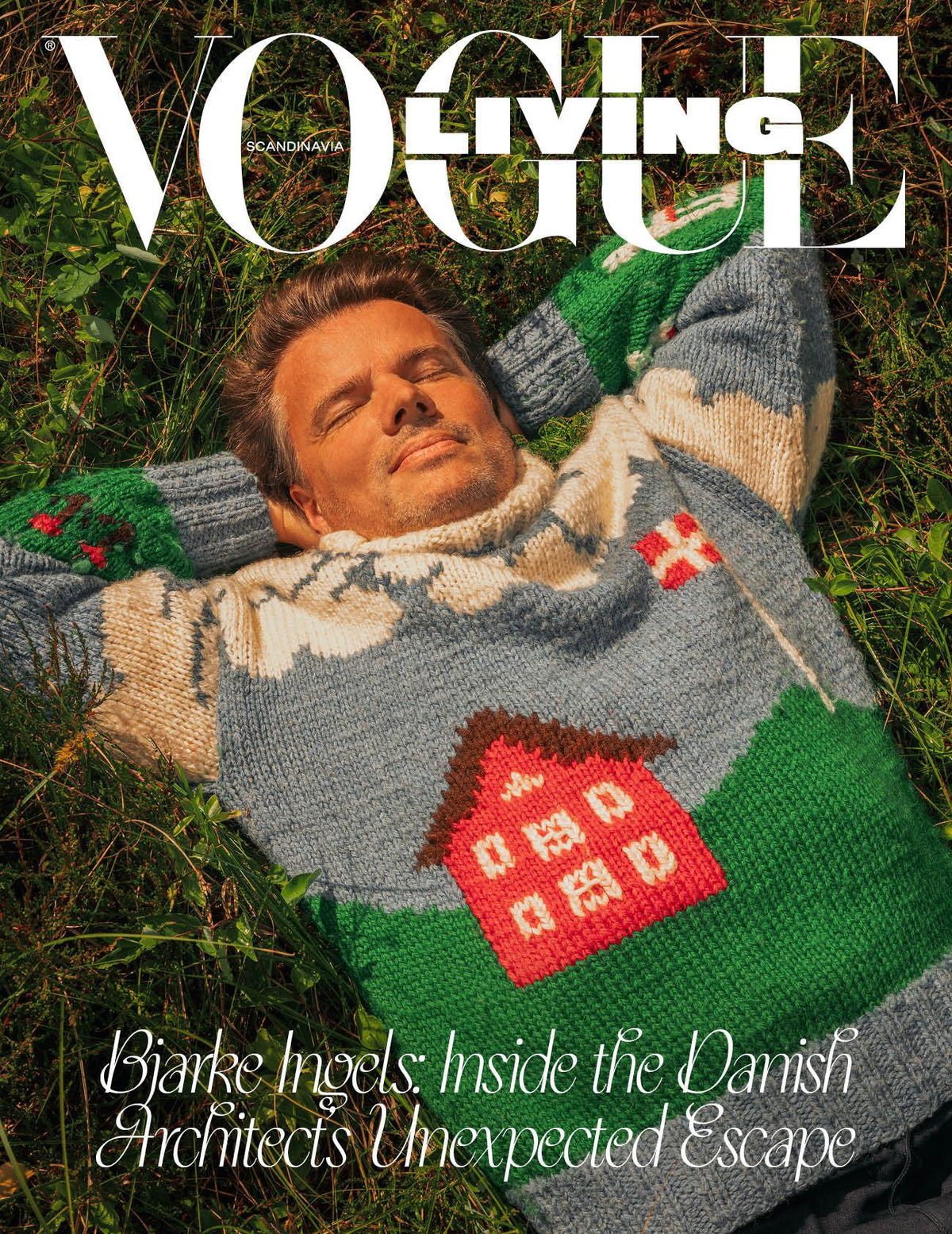
“The previous owners had been very good to the house,” Ingels says, noting that almost nothing had been changed over the years. “In Denmark, you buy summerhouses fully furnished, and a lot of the original, Swedish hand-painted decoration and most of the furniture – like the dining chairs and the table – were original, made by the workers. So, I moved into this perfect fantasy.” However, he had one condition in his offer: to also acquire the cosy sweater knitted by the former owners’ daughter, depicting the summerhouse. “It’s an iconic sweater. I like to say that it’s the most expensive sweater I’ve ever bought,” he chuckles.

Photo: Christian Møller Andersen
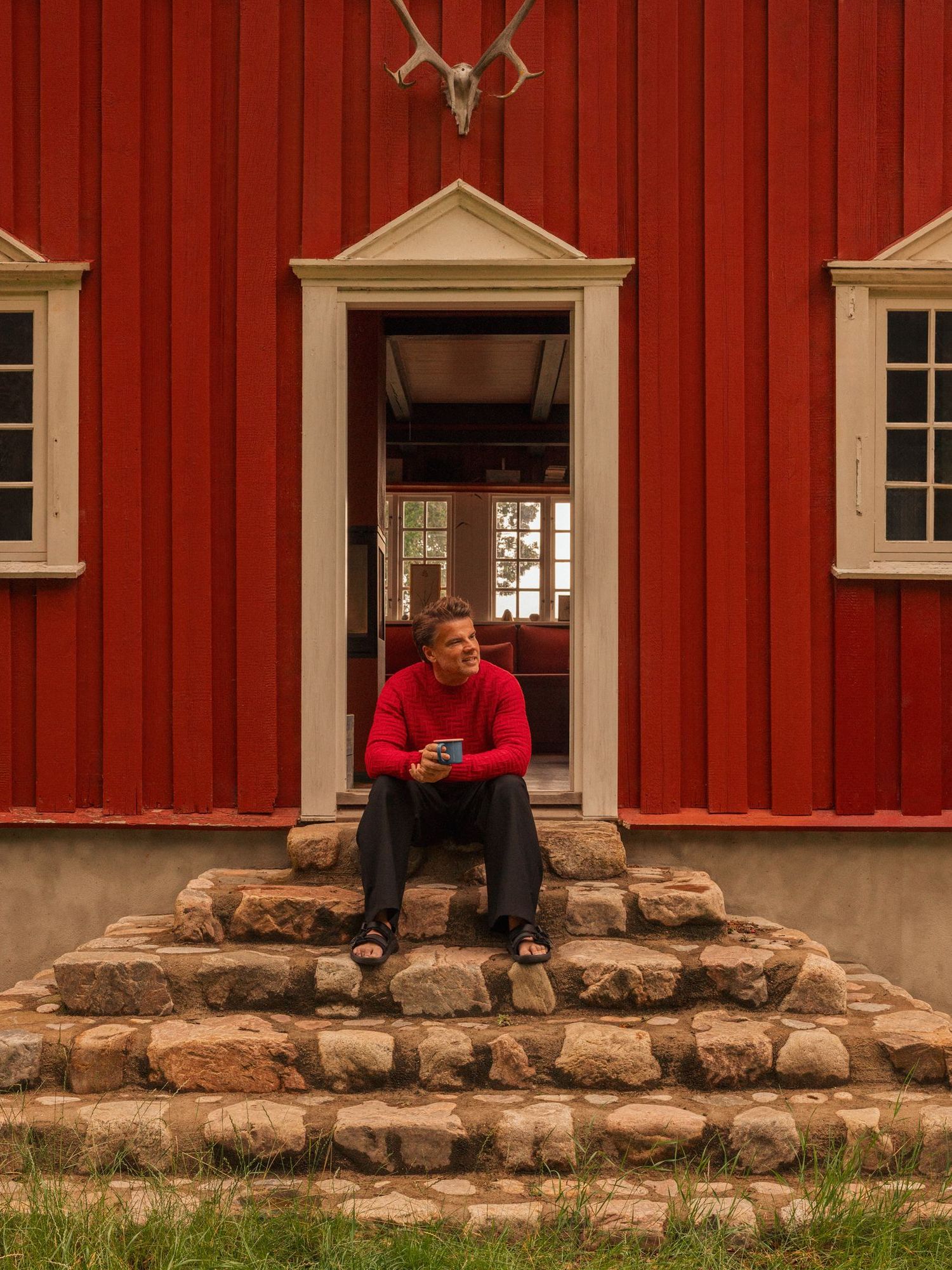
One of Bjarke’s favourite things to do at the house is to sit on the stone-crafted pyramid stairs on the cottage’s forest- facing side. His sweater complements the Falu red facade, a pigment derived as a byproduct from the copper mines in Falun, Sweden, and traditionally brushed onto Swedish summerhouses since the 17th century. Knitted sweater, €1,990. Prada via Mytheresa. Trousers, €1,720. The Row via Mytheresa. Ring, €2,480. Griegst. Sandals, €280. Birkenstock x Maharishi.
While well-preserved, there were some tweaks that Ingels sought to make – not to alter the soul of the summerhouse, but to subtly bolster its character. After purchasing it in 2021, he spent an entire summer simply soaking up the place, imagining, before gradually beginning with his edits, with the help of architect Anne-Charlotte Wiklander (who worked at BIG before setting up her own firm) and carpenter Beier Davidsen. “It really becomes about asking the house what it wants,” he says, adding that there’s a certain discretion required when renovating places like Fjordglimt. “You become a custodian of that house and that identity. I would say my interventions have primarily been to correct things that didn’t fit the house.”
Being a listed building, the summerhouse’s exterior couldn’t be modified. There, its dual legacy manifests most vividly: Scandinavian pinewood, drenched in vibrant Falu red (a pigment derived as a byproduct from the copper mines in Falun, Sweden, and traditionally brushed onto Swedish summerhouses since the 17th century), meets a slanted, thatched roof, a hallmark of rural Danish houses tracing back thousands of years. Step inside, and you’re greeted by pinewood-clad interiors that hum with Swedish heritage. Signature saturated Falu hues of red, yellow and green reverberate throughout the house, harking back to the original palette of the place.
It’s an iconic sweater. I like to say that it’s the most expensive sweater I’ve ever bought
Bjarke Ingels
“The funny thing is, this was definitely the first time I really got to play a lot with colour – architects rarely work with it,” Ingels muses. “And I actually had so much fun being a restoration architect.” Although familiar with typical Scandinavian summerhouse aesthetics, Ingels drew some renovation inspiration from the famed, 1880s cottage-turned-museum of eminent Swedish painter Carl Larsson, in Sundborn.
Spread across 75 square metres and comprising two floors, the house is “the perfect size” for Ingels’ family, while also comfortably accommodating guests. In the original layout, the ground floor was divided into several smaller rooms, which Ingels transformed into one, flowing space – save for the bathroom – anchored by the fireplace. Scattered throughout are the historic furnishings Ingels naturally kept (“They set the tone for the entire house”), their old-world charm echoed in the hand-painted ornaments and exposed beams that run across the cottage, swathed in Falu green and contrasting with the crisp white ceiling.
/Bjarke_Ingels_Vogue_Scandinavia_2025_CMA_9_C9_A2522_Web_37ca1bc9f6/Bjarke_Ingels_Vogue_Scandinavia_2025_CMA_9_C9_A2522_Web_37ca1bc9f6.jpg)
The master bedroom, rendered in milky white peppered with Falu green accents, and bathed in natural light thanks to a row of generous windows. To unveil the soaring ceilings, Ingels opened up the attic. Bedside lamps. Nightworks. Custom built-in bed. Beier Davidsen. Cushions and bed textiles. Kvadrat. Photo: Christian Møller Andersen
“The only sort of modern element [in the house] is the kitchen,” Ingels notes. Completely remade, he collaborated with Reform Copenhagen and Belgian designers Mulle Van Severen – the latter contributing a coloured, plastic cuttingboard-crafted material harnessed in the kitchen – to design a quaint, dusty blue and Falu red heart for his summer retreat. The minimalist bathroom was the second of only two spaces that received a full makeover, where the Falu green spills over to the solid-shaded tiles courtesy of Danish brand Made a Mano.
“Everything we’ve done is very Scandinavian simple – of course, with a colour palette that’s very traditional, but also actually feels very fresh,” Ingels says. More up-to-date compared to its 1918 roots, yes, yet “everything feels as if it has always been there.”
Upon climbing the swirly staircase, more Falu fireworks await: the kids’ and guest rooms are cloaked in rich red and honeyed yellow, respectively, complete with Ingels-designed, built-in drawers and matching upholstery. A dash of airiness comes by way of the master bedroom, rendered in milky white peppered with Falu green accents, and bathed in natural light thanks to a row of generous windows. To unveil the soaring ceilings, Ingels opened up the attic and enclosed the balcony to create a quiet nook for a desk – a treasured creative perch for the architect. “There, you can look over the sea, the fjord, the meadow…,” he trails off. “That’s the perfect place to do some writing or sketching.”
/Bjarke_Ingels_Vogue_Scandinavia_2025_CMA_9_C9_A2558_Web_10e7336eb2/Bjarke_Ingels_Vogue_Scandinavia_2025_CMA_9_C9_A2558_Web_10e7336eb2.jpg)
The kitchen, made in collaboration with Reform Copenhagen and Belgian designers Muller Van Severen, is the only modern element of the house. The latter contributed a coloured, plastic cuttingboard-crafted material harnessed in the space. Sockets, Switches. Both Katy Paty. Faucet. Toni Copenhagen and Bjarke Ingels Group. Brass counter tops. Gørtler Finn Jakobsen. Photo: Christian Møller Andersen
As we talk about Ingels’ process of flirting with these punchy hues and restoring the summerhouse to its deserved glory – like stitching together a riveting narrative – it paints a familiar connection to where it all started for the architect. “I was good at drawing, so I wanted to be a cartoonist, creating graphic novels,” he tells me. But since there weren’t any cartoon schools in Copenhagen, Ingels ended up enrolling at the Royal Danish Academy, where he studied architecture, part of the art department. “The first two years of the school were actually very focused on drawing skills, so I thought, maybe I’ll spend a few years getting good at drawing the backgrounds, like the buildings and landscapes,” he recalls. “And then I just got increasingly fascinated by the background.”
A study trip to Barcelona reinforced this budding interest and curiosity, as Ingels was introduced to the works of local greats like Antoni Gaudí and Enric Miralles. He noticed: “They are like storytelling, but in built form … It was eye-opening.”
I love going there alone, actually. The energy up there, the spirit … The whole house feels like a big warm hug
Bjarke Ingels
Ingels kicked off his career at the acclaimed international architectural firm OMA, before co-founding a company called PLOT in 2001. Four years later, at just 31, he established Bjarke Ingels Group (BIG) – the venture that would cement his reputation as one of the most influential architects in the world. Over the past two decades, BIG has envisioned a slew of iconic projects – from the LEGO House in Billund and VIA 57 West in New York to The Twist in Jevnaker, the 8 House in Copenhagen and the MÉCA in Bordeaux. Each reflects the company’s singular, style-defying approach: merging contemporary, high-tech features with a sense of playfulness and a steadfast commitment to protecting the health of our planet. Terms like ‘hedonistic sustainability’ and ‘pragmatic utopianism’ are often linked to Ingels’ work. “I love oxymorons… You know, a power plant that’s also a park or a ski slope, a museum that is also a bridge,” he says. “It’s almost like every project has this internal contradiction, but it fuses into a new hybrid.”
/Bjarke_Ingels_Vogue_Scandinavia_2025_CMA_9_C9_A1760_Web_52ef6be29e/Bjarke_Ingels_Vogue_Scandinavia_2025_CMA_9_C9_A1760_Web_52ef6be29e.jpg)
Shirt, €190, Trousers, €160. Both Tekla. Bracelet, €5,500. Elhanati. Watch. Talent’s own. Ring, €2,480. Griegst. Photo: Christian Møller Andersen
/Bjarke_Ingels_Vogue_Scandinavia_2025_CMA_9_C9_A2258_Web_b60bf3a3c8/Bjarke_Ingels_Vogue_Scandinavia_2025_CMA_9_C9_A2258_Web_b60bf3a3c8.jpg)
Much of the furniture, like this dining set, is the original furniture crafted for the house. As Bjarke notes, the previous owners had been “very good to the house”, changing virtually nothing over the years. Photo: Christian Møller Andersen
Ultimately, however, for Ingels, “architecture is really about performance”. He harbours a certain, philosophical perspective on his work, waxing poetic: “To design something is to give form to that which has not yet been given form – in other words, to give form to the future,” he continues. Much like how graphic novels create alternate worlds, he notes, “architecture is the art and science of turning fiction into fact.”
/Bjarke_Ingels_Vogue_Scandinavia_2025_CMA_9_C9_A1448_Web_9b0355ef24/Bjarke_Ingels_Vogue_Scandinavia_2025_CMA_9_C9_A1448_Web_9b0355ef24.jpg)
Swedish hand-painted decoration is woven throughout the home. In completing the project, Bjarke took inspiration from the 1880s cottage-turned-museum of eminent Swedish painter Carl Larsson, in Sundborn. Photo: Christian Møller Andersen
Although he juggles a hectic schedule, Ingels escapes to the summerhouse whenever possible. “I love going there alone, actually. The energy up there, the spirit … The whole house feels like a big warm hug,” he says. Over time, the place has become more than just a salty-scented sanctuary, a breather from a jam-packed roster – it’s evolved into a source of inspiration for his craft, particularly when it comes to embracing tradition. Ingels points to recent projects in Aarhus, where thatched roof material was incorporated into the buildings, as well as one of BIG’s current developments, the Gelephu International Airport in Bhutan, whose superstructure features mass timber enveloped in local paints and adorned with traditional Bhutanese wood carvings. “I think, in some way, the time I’ve spent taking care of Fjordglimt has definitely influenced my work in general,” he reflects.
/Bjarke_Ingels_Vogue_Scandinavia_2025_CMA_9_C9_A2204_Web_d45b236d90/Bjarke_Ingels_Vogue_Scandinavia_2025_CMA_9_C9_A2204_Web_d45b236d90.jpg)
Kitchen. Designed by Reform and Muller Van Severen. Counter top, Stove top cover. Both Gørtler Finn Jacobsen. Photo: Christian Møller Andersen
/Bjarke_Ingels_Vogue_Scandinavia_2025_CMA_9_C9_A2569_Web_b321f6bec5/Bjarke_Ingels_Vogue_Scandinavia_2025_CMA_9_C9_A2569_Web_b321f6bec5.jpg)
Every inch of the home, even the bathroom, is done “very Scandinavian simple” with a “colour palette that’s very traditional, but also actually feels very fresh”. Tiles. Made a Mano. Faucet, Mirror. Both Toni Copenhagen. Sink. Ceramica Cielo. Photo: Christian Møller Andersen
As for one of his favourite things to do while at the summerhouse? “Just sitting on” the stone-crafted pyramid stairs on the cottage’s forest-facing side. On sun-soaked afternoons, when family or friends are around, a stack of waffles is enjoyed on those same steps, while gazing at the untamed surroundings that stage a fairy tale of their own.
“The nature is very protected – you can’t have fences or hedges, and you can’t put a big swimming pool in the yard. So, the animals roam freely,” Ingels explains. The summerhouse’s furry frequenters include foxes, deer, owls, and, come autumn and spring, Icelandic horses grace the meadow. On a clear, calm day, the view stretches all the way to Sweden. He smiles, concluding, “It’s one of the most beautiful places in Denmark.”
Photographer: Christian Møller Andersen
Stylist: Rikke Jung Larsen
Talen: Bjarke Ingels
Makeup Artist & Hair Stylist: Mette Schou
Set Design: Tine Daring