
Netflix's Frankenstein has hit our Netflix streams and the Academy Awards buzz is real. Here, we explore the role jewellery – that of Tiffany & Co., specifically – played in the film's visual impact
Tiffany & Co. has long played a starring role in cinema lore – its legacy intertwined with Hollywood itself. The image of Audrey Hepburn in her little black dress, tiara and pearls, gazing into Fifth Avenue windows in Breakfast at Tiffany’s, defined a 20th-century vision of modern American glamour. Now, with Guillermo del Toro’s Frankenstein, the house returns to film not as a backdrop, but as a collaborator.
This new cinematic partnership between Tiffany & Co. and Netflix marks the first time the house has opened its vaults on this scale since Baz Luhrmann’s The Great Gatsby back in 2013. If Gatsby was a vision of Jazz Age excess, del Toro’s Frankenstein offers something else entirely: a gothic world steeped in myth, modernity and melancholy. “I particularly like it when jewellery is in a film and it’s not the object of a heist,” Christopher Young, Tiffany’s vice president and creative director of patrimony and global creative visual merchandising, told me. “Del Toro’s world is layered, poetic and at times fantastical. It’s an ideal canvas for a collaboration with Tiffany.”
Related: “It had to be close to him”: Sofia Coppola lenses Jacob Elordi in Cartier’s new Love bracelet
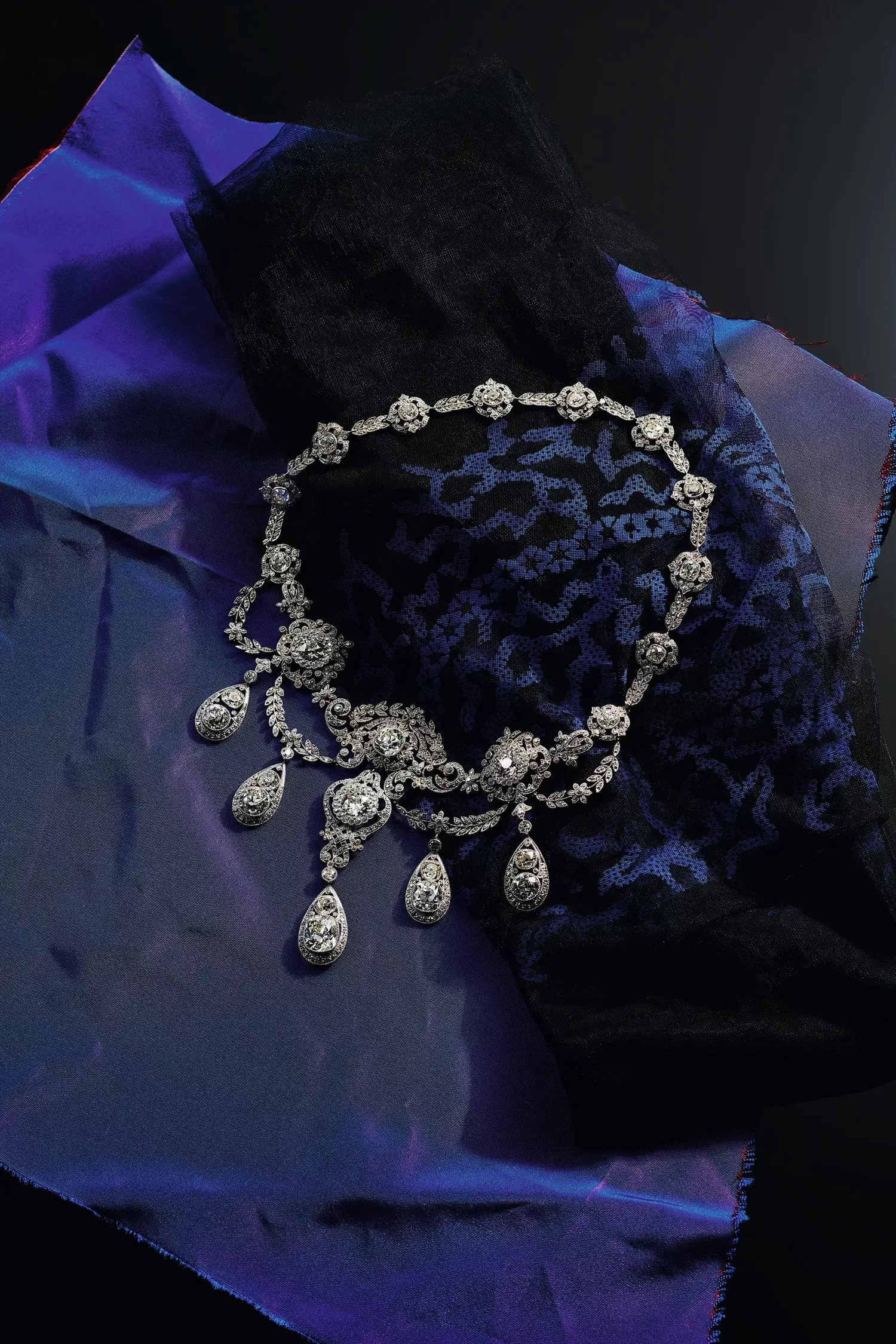
Wade Necklace. Photo: Courtesy of Tiffany & Co.
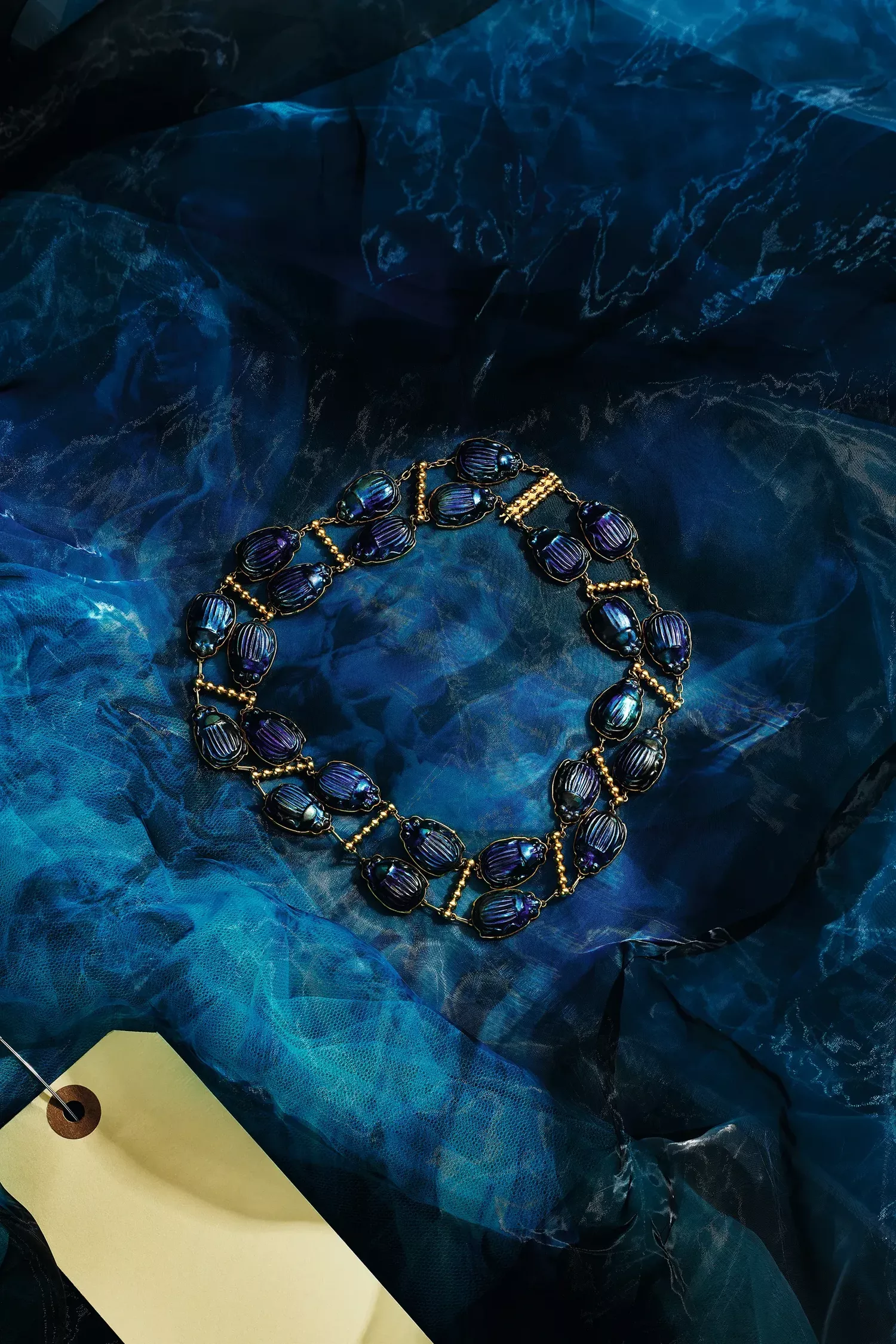
Favrile Glass Scarab Necklace. Photo: Courtesy of Tiffany & Co.
Mia Goth’s Elizabeth is a distinctly modern interpretation of Mary Shelley’s original character: intellectual and deeply connected to the natural world. One of the key pieces she wears is a 1914 necklace designed by Meta Overbeck, made of gold and set with Favrile glass scarabs. The pressed glass beetles were produced in Louis Comfort Tiffany’s glass furnace in Corona, Queens, in varying sizes and with a distinctive blue-green iridescence. First listed in Tiffany’s Blue Book in 1909, this type of Favrile beetle jewellery appeared in a range of forms through 1914. This is the first time the necklace has been worn in a contemporary context, and it appears prominently throughout the film. “You even see her in the film, making a watercolour of a beetle that’s crawling on her hand,” Young explained.
The Wade Garland Necklace is the crown jewel of Tiffany’s contribution to Frankenstein: a Paulding Farnham design from 1900, composed of more than 40 carats of European-cut diamonds set in an open pattern of platinum swags and flowers. Originally created for American heiress Ellen Garretson Wade, the piece had spent most of its life behind glass, appearing only in exhibitions and books. “It hadn’t been worn since 1900,” Young said. “When Mia tried it on and it fit perfectly, it was kind of a Cinderella moment.”
A quintessential example of Tiffany’s garland style, the necklace is defined by its platinum craftsmanship and floral motifs, with diamonds set in fine millegrain settings that lend it a lace-like delicacy that was typical of the period. Crafted more than 125 years ago, it also reflects a moment of technological transformation, made possible by the invention of the acetylene torch, which allowed artisans to manipulate platinum with unprecedented precision.
Outside Tiffany’s Fifth Avenue flagship, the narrative continues. To mark the premiere, the brand turned the windows into a theatrical homage to Frankenstein. Designed in collaboration with del Toro, each window reframes a pivotal scene: the barren Arctic landscape, Victor’s lightning-spiked tower, as well as Elizabeth’s world in objects displayed on her dressing table. Mia Goth’s likeness dominates one of the windows, as we see her reflection in the mirror. Young excitedly pointed out that she was the first actress to appear in a Tiffany window since Audrey Hepburn. Behind a magnifying glass, the Wade necklace appears like a prized artefact at the Natural History Museum. “The idea was to bring the magic of the movies to the sidewalks of New York,” Young said. It’s theatrical and a little kitschy, but also reverent.
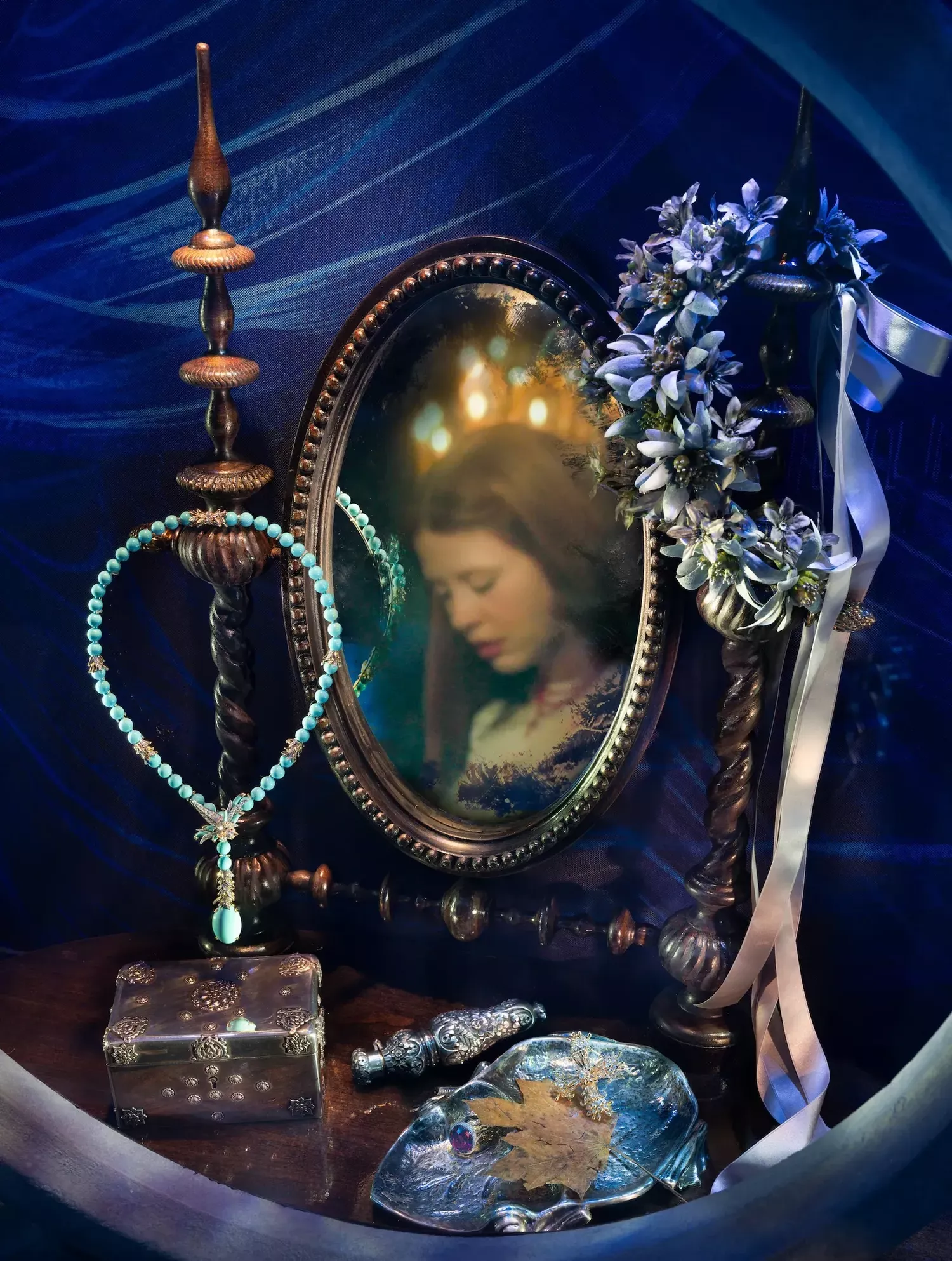
Photo: Ricky Zehavi. Courtesy of Tiffany & Co.
Tiffany & Co. is one of America’s most recognisable status symbols, an institution dating back to 1837 and responsible for major innovations in marketing: the adoption of “Tiffany blue” packaging in 1851; the invention of the modern, high-set engagement ring in 1886; and the extraordinary work of legends such as Jean Schlumberger, Elsa Peretti, and Paloma Picasso.
America’s leading luxury jeweller has never been shy about scale. So the decision to lend its most fragile treasures to a film makes sense within Tiffany’s broader strategy: keeping a firm hand on the cultural status quo. Partnering with Netflix on a major release may well be a genius move when it comes to inspiring the next generation of jewellery-lovers. As Young put it: “[The film] allows people to learn something they didn’t know, to maybe wear jewellery they hadn’t thought about. It opens doors for people to express their own creativity in new ways.”
In del Toro’s hands, Tiffany’s jewels become more than glamorous props; they are relics that bridge centuries. Mary Shelley’s modern myth – written by an 18-year-old woman with radical ideas about creation and identity in 1818 – finds an unexpected ally in Tiffany’s vaults, and is turned into fantasy for a 2025 audience.
Guillermo del Toro’s Frankenstein is in cinemas now and will be available to stream globally on Netflix from 7 November.
This article was originally featured in British Vogue