
In the sea of the SS26 designer debuts, the stakes were especially high at Chanel. Enter Matthieu Blazy, the man tasked with charting the future of one of our most storied houses. Blazy’s Chanel has arrived, and boy oh boy is it beautiful
Fashion cannot exist without change, but some changes reach beyond the season. When it was announced that Chanel was without a creative director, people across the industry looked to the house in nervous expectation. For nearly 40 years, Chanel had articulated the vision of one man: Karl Lagerfeld. After he died in 2019, his longtime deputy Virginie Viard had carried on his style. Viard’s departure in June 2024 opened one of the highest seats in fashion, but also raised the possibility that Chanel’s taste could take a startling turn. Matthieu Blazy, a comparatively young designer who had distinguished himself doing surprising things with leather at Bottega Veneta, was not considered an obvious choice, and when he was announced as artistic director, he had the task not just of working his way out from a very long shadow but of showing where, as a designer of largely unknown capacities, he might go. The future course of the house would come down to his October debut.
/Chanel_Issue_28_9_56dedd7fd3/Chanel_Issue_28_9_56dedd7fd3.jpg)
Knitted top, €3,900, Knitted skirt, €7,800, Bag with flower embroidery, €22,000, Lambskin slingbacks, €1,400. All Chanel. Photo: Hasse Nielsen
When the night of that first show in Paris arrives, the vaulted backstage of the Grand Palais, a Beaux Arts wonder on the banks of the Seine, shivers with preparation. Models rush. Forty minutes before the showtime of 8 p.m., Blazy appears, looking tense and pale. “I’m a bit all over the place, to be honest – I’m going to have a cigarette,” he says, and rushes off again.
Related: “I was not living my truth or feeling fulfilled”: Anine Bing on divorce, therapy and her new era
Blazy arrived at Bottega after a nearly 20-year career as a deputy at work in the shadows, a secret weapon who had become an open secret. His work at Bottega was characterised by a sophisticated understanding of craft and its capacity to hold apparently contradictory ideas in surprisingly human wholes. “It’s strength meets softness, structure meets fluidity,” says Ayo Edebiri, who is attending the show as a Chanel ambassador. “But also, he sees every type of woman. I feel like myself in a really gorgeous dress, but it could be sexy or demure.” Nicole Kidman, a longtime affiliate of Chanel, says, “From the moment I met Matthieu, I was struck by the way he approaches everything with his heart first.”
My mum describes it as the stress when you drop your kids off for school on the first day – you know it’s going to be fine, but still.
Matthieu Blazy
When the designer reappears, he makes a brisk tour, smiles widely at his colleagues, then retreats to his own nerves. “My mum describes it as the stress when you drop your kids off for school on the first day – you know it’s going to be fine, but still,” he says. He glances from the screens to the models, then adds, with an air of cautious contentment, “It feels like the big leap.”
Some weeks earlier, one warm Wednesday evening in July, I met Blazy on the steps of the Église Saint-Germain-des-Prés. “I live not far from here,” he says, rising from his crouch on the church steps to greet me. “And my father had a gallery nearby, so growing up I was here constantly.” He is neither tall nor short, and is wearing his signature white T-shirt – no logo – with a natural-coloured sweater around his shoulders and relaxed, faded blue jeans falling onto black crinkled lambskin loafers of his own design. His light brown hair, worn in an all-purpose crop, bears flecks of grey.
/Chanel_Issue_28_8_f6f3e034ad/Chanel_Issue_28_8_f6f3e034ad.jpg)
Silk organza top, €13,300, Satin dress, €36,000, Metal, resin and strass earrings, €1,090, Lace-up shoes, €1,550. All Chanel. Photo: Hasse Nielsen
/Chanel_Issue_28_4_6461448878/Chanel_Issue_28_4_6461448878.jpg)
Handpainted viscose and twill jacket, €6,600, Top, €3,400, Metal and resin earrings, €690. All Chanel. Photo: Hasse Nielsen
“There’s a kind of creative who constantly needs to lead, and then there’s a kind of creative who’s willing to step back, listen, and offer the services of their brain, their Rolodex, their aesthetic intention,” the artist Theaster Gates, who collaborated with Blazy at Bottega on leather-clad ceramic pieces for the Mori Art Museum, tells me. In a pressured industry, Blazy holds a reputation for translating artistic freedom into surprising market success while also managing to be, as Simons put it, “one of the loveliest people I’ve ever met in my life”.
“He’s a remarkable choice for Chanel, in terms of his own personality and the way that comes across in his clothes,” Andrew Bolton, the curator in charge of The Metropolitan Museum’s Costume Institute, who two years ago organised a tremendous retrospective of Lagerfeld’s work, told me. “He has a very democratic and egalitarian approach to design, which I think will be enormously helpful to Chanel. I always felt with Karl that there was a sense of the sublime in his work, achieved through luxury. Matthieu’s sublime is a bit quieter. He’s very much engaged with an aesthetics of the everyday.”
/Chanel_Issue_28_5_a487ea0558/Chanel_Issue_28_5_a487ea0558.jpg)
Tweed jacket, €12,300, Skirt, €6,100, Leather pumps, €1,250. All Chanel. Photo: Hasse Nielsen
For the first several weeks of his courtship by Chanel, he says, he had no idea what was going on. He was on a train to Venice when he received a call telling him which job he was up for. He flew to London to talk with Leena Nair, the brand’s CEO. He travelled to Normandy to visit Alain Wertheimer, the company chair. “We almost didn’t speak about Chanel,” Blazy says. “He told me, ‘If you’re in front of me, it means you’re supposed to be a good designer, so let’s not talk about work.’” They conferred instead about childhood, about family, about their shared interests in art. During the last five minutes of the interview, Wertheimer circled back to fashion.
“He asked me, ‘Do you think Chanel is modern now?’ I said, ‘I think the pillars are still modern, but we can push it.’ ” On which Wertheimer smiled. In the car home, the driver blasted French rap with the windows down, and Blazy allowed himself a moment of contentment. “That’s when I thought, ‘Maybe this could work’,” he says.
Couture doesn’t need to be heavy. It doesn’t need to be big. It’s something about the making, how it falls on the body
Matthieu Blazy
Start with a coat. A men’s sport coat – British, say – in tweed: the everyday archetype of refined masculinity. Put it on a woman. Take a pair of shears to the bottom; cut it at the hip. Close the lapels. Add a button or two. “Suddenly, you have the archetype of a Chanel jacket – from a man’s,” Blazy tells me. He knows this because he undertook exactly that operation with his team on his first day in the Chanel studio. It was an exercise in stripping away a century of thickly layered development at the house, returning to the original shock of the new.
“The way Karl looked at Chanel is a very specific point of view on what Chanel is,” Blazy explains. “When you go back to the early years of Gabrielle Chanel, a lot of things happened that haven’t been told yet, even though they resulted in codes.”
/Chanel_Issue_28_2_b44c0997ff/Chanel_Issue_28_2_b44c0997ff.jpg)
Silk organza top, €13,300, Satin dress, €36,000, Metal, resin and strass earrings, €1,090. All Chanel. Photo: Hasse Nielsen
/Chanel_Issue_28_10_f8d16a1cde/Chanel_Issue_28_10_f8d16a1cde.jpg)
Tweed jacket, €11,600, Viscose and cotton top, €4,500, Wool skirt, €4,900, Wool and silk trunks, €1,600, Metal, resin and strass earrings, €890, Leather bag, €6,700. All Chanel. Photo: Hasse Nielsen
Blazy had spent time in the house archives while doing his own research. On a hunch, he spoke with Jean-Claude and Anne-Marie Colban, the brother and sister who direct the storied men’s shirting tailor Charvet. “They knew things I didn’t know – that, for example, Coco would buy gifts for her boyfriend in that store,” he says.
The boyfriend was Arthur “Boy” Capel, an English polo player whom Chanel was madly in love with from 1909 until his death a decade later – the years when her style, career, and mystique seemed to materialise from the mist.
“All my friends wear their boyfriends’ clothes,” Blazy reasons. “She didn’t want to look like a woman that men bought everything for. She liked to ride horses. She was always on the go,” he says. And her clothes were conceived by pragmatic circumstance. Blazy’s Coco Chanel is less a visionary from nowhere than a woman who made thrilling clothes to answer highly personal needs. “What you quickly find out is that Chanel could not exist, in the aesthetic we all know, if she was not in love with that man,” Blazy says.
/Chanel_Issue_28_3_709a33b651/Chanel_Issue_28_3_709a33b651.jpg)
Block stripe jacket, €14,900, Silk skirt, €5,100. Metal, resin and strass earrings, €1,290, Lambskin bag, €5,900, Leather pumps, €1,250. All Chanel. Photo: Hasse Nielsen
Blazy puts a lot of stock in the house’s early affinities for what would now be called globalised culture. From the house archivist Odile Prémel, he learned that one of Coco’s earliest coats used a colourful pattern from Turkmenistan, rendered in monochrome. In the archive of Azzedine Alaïa (an obsessive Chanel collector), he studied a piece with a distinctive diagonal stripe. “There are no references like that in the European world!” he says.
“There is something about the Chanel lightness that I really want to explore,” he says. “Couture doesn’t need to be heavy. It doesn’t need to be big. It’s something about the making, how it falls on the body.” In the Belgian style, he likes to work in the round, with scissors in hand. “I might start with a suit, and by the end of the day, it will become a dress. The first time I cut a piece – or a bag! – everyone was, well, not horrified, but surprised.”
Blazy’s second show was held in December in New York. “I want to connect to the city in the way I see it, but also in the way that Chanel is linked to America – Gabrielle went to New York and, later, Hollywood,” he explains. The show played with New York cinematic archetypes – “the woman who goes to buy her groceries on the Upper East Side, the Lower East Side kid, the girl from Brooklyn” – celebrating the pluralism of the street.
Blazy never shows even his closest deputies the runway set before the day of the show, the better to keep it a completely fresh space. As guests stream into the Grand Palais on a Monday night in October, they first look up. Suspended from the ceiling (and half sunken into the ground) are 15 enormous planets.
I wanted something very joyful, so it’s an explosion of flowers, almost like a Flemish painting. That’s what I see in it. My team sees a piña colada
Matthieu Blazy
The lights go down; the first look crosses the floor. Blazy has created a two-button Chanel jacket from the silhouette of a man’s grey coat, with pressed trousers – the version of the garment he cut on his first day in the studio. In her left hand, the model carries his take on the classic 2.55 bag, fitted with pliable metal within the stitching, so that they can be scrunched and bent into new, ragged forms. The third model wears a blouse of the burgundy colour, which Coco Chanel lined her bags with. He divided his show into three chapters, and this first, called Le Paradoxe, brings power and seduction into conjunction.
Then all at once there is a man’s white shirt with an evening skirt – “the ultimate paradox,” in Blazy’s words. The shirt was made with Charvet fabric and technique; simple and elegant, a kind of reminder of Coco Chanel’s love.
Blazy’s second chapter is called Le Jour, as in the everyday, the movement through ordinary life. “The silhouette is already starting to be more feminine,” he explains. What looks at first to be a classic Chanel suit is actually a skirt hung directly from the hem of a sweater, like a dress; it sways and dances about the hips as the model walks. Then come suits with men’s shirt collars and inspired by the patterns of menswear, rendered in dégradé to become flat, like a woman’s dress: the two sides of the paradox merged in a single garment. Blazy exaggerated the frayed hems that Coco Chanel loved into ragged edges by letting the cloth be overtaken slowly with tiny hanging strings of beads, and developed the idea in “scarecrows”: fine cotton woven to resemble a potato sack, with strands of raffia in the blouse like wheat.
/Chanel_Issue_28_6_b402b1e4ea/Chanel_Issue_28_6_b402b1e4ea.jpg)
Handpainted viscose and twill jacket, €6,600, Skirt, €5,400, Metal and resin earrings, €690, Printed calfskin bag, €7,000. All Chanel. Photo: Hasse Nielsen
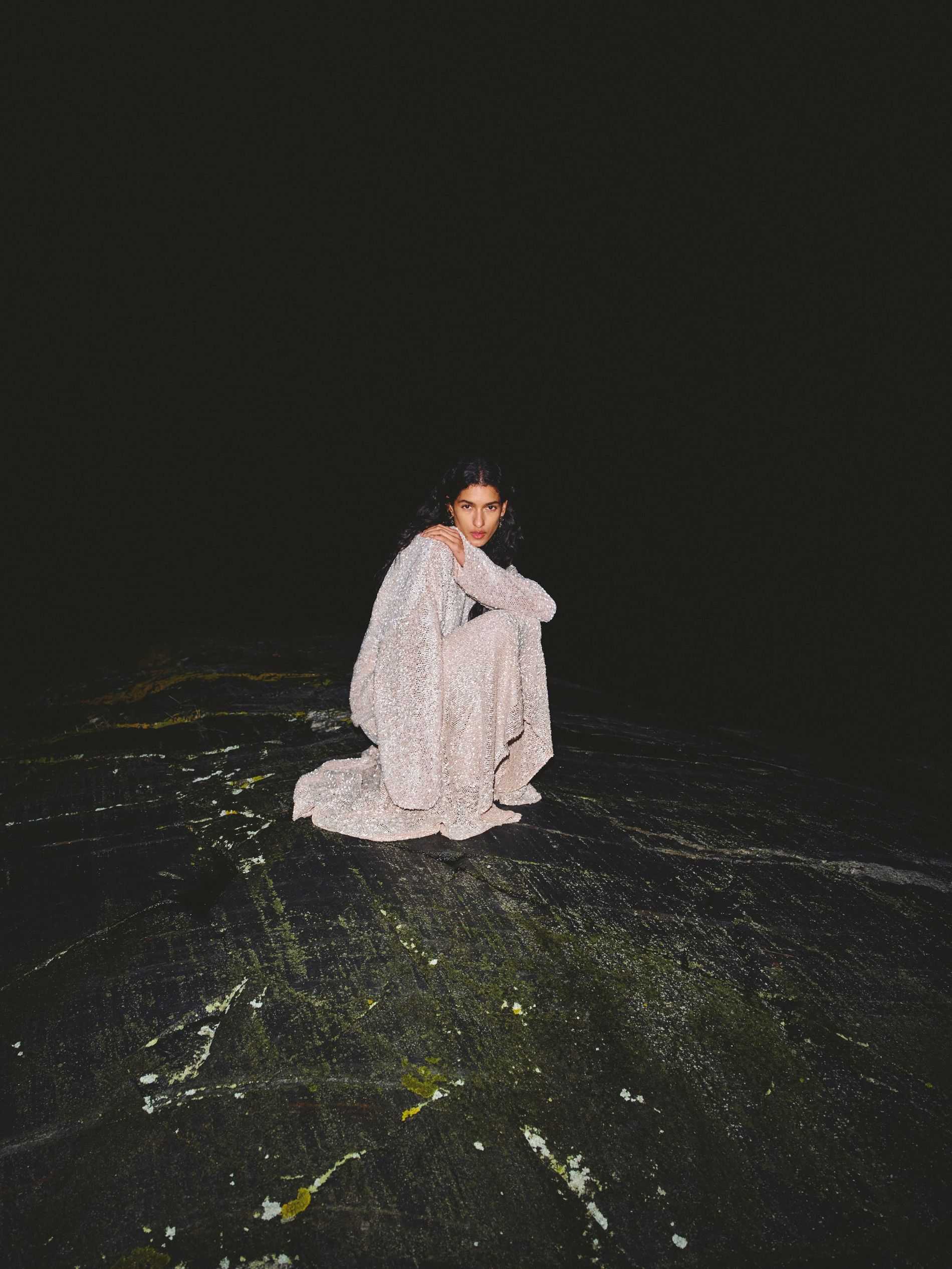
Cotton sequin top, €7,900, Skirt, €15,600. Both Chanel. Photo: Hasse Nielsen
“Everybody who’s been paying attention knows that Coco Chanel came from a peasant’s life,” says the actor Pedro Pascal, who marvelled at the looks from the audience. Blazy explains, “Coco Chanel took the clothes of the worker – clothes that you could move in – and gave them to the aristocracy. It becomes the modern wardrobe.” In a hall filled with people who had emerged from black cars, it was, to him, an insistence on the fashion power of the everyday.
The last chapter, L’Universel, is Blazy’s tribute to Chanel’s global roots and pluralistic present. The patterns are “zoomed-in” versions of tweed, which come to resemble textiles from across the world. There are suits. There are classic dresses embroidered with bright raffia flowers. Then comes the final look, a skirt, worn with a simple white T-shirt and inlaid with colourful feathers and blooms, which required hundreds of hours of handwork to create. “I wanted something very joyful, so it’s an explosion of flowers, almost like a Flemish painting. That’s what I see in it. My team sees a piña colada.” He grins. The model Awar Odhiang, who wears the dress, smiles widely and takes a wild spin around the centre of Blazy’s floor with her hands in the air. ”
At last, the designer appears from a stairwell. The Grand Palais is on its feet and sending cheers. Blazy gives Odhiang a deep hug, jogs around the runway, and flees toward the exit, smiling. That night, he says, he will allow himself to walk the long way home.
Photographer: Hasse Nielsen
Stylist: Helene Juliussen
Model: Jennifer Matias
Hair Stylist: Linda Shalabi
Makeup Artist: Josefina Zarmén
Stylist Assistant: Charlotte Moss
Photographer Assistants: Frederik Kastrupsen, Gustaf Hagstrand, Majken Hansen
Production: Linkproduction