
Together with Longchamp, textile artist Caroline Hélain turns coastlines into clothes. Ahead of her first-ever collaboration, we meet in Brussels to talk about trading her pen for scissors, Normandy's chalk cliffs, and why she longs to sail Stockholm's archipelago
Through a non-descript door in a residential area of Brussels, past a delicately detailed stone entryway and up a flight of crooked stairs sits Caroline Hélain's studio. When we enter, the artist is dressed in pinstripe wide-leg trousers and a pale pink T-shirt from her new Longchamp collaboration (the first ever for Hélain). It features one of her colourful, abstract patchwork landscapes on the breast pocket.
About the room, we find pieces from the rest of the collection spanning leather goods and ready-to-wear: On the Daylong line, her patchworks are worked in leather across a mini bag and a weekender. On the knitwear, sweaters and long dresses, her compositions run the full length of the piece; the standout is a sleeveless top in calf leather and bouclé virgin wool, dunes in leather beneath a sky worked entirely in wool. It is the middle of a heat wave, the kind of sweltering Brussels day that makes anyone reconsider knitwear. And yet, within minutes of seeing the collection laid out across her workbench, I've pulled a sweater over my head anyway. The clothes, it turns out, are more persuasive than the weather.
Hélain has lived in Belgium for 20 years, having moved there from France. Brussels made it easy to understand why, showing its best side beyond the studio window: Art Nouveau facades, eclectic shopfronts, streets left appealingly unpolished, a matcha latte taken slowly in the shade of a back garden.
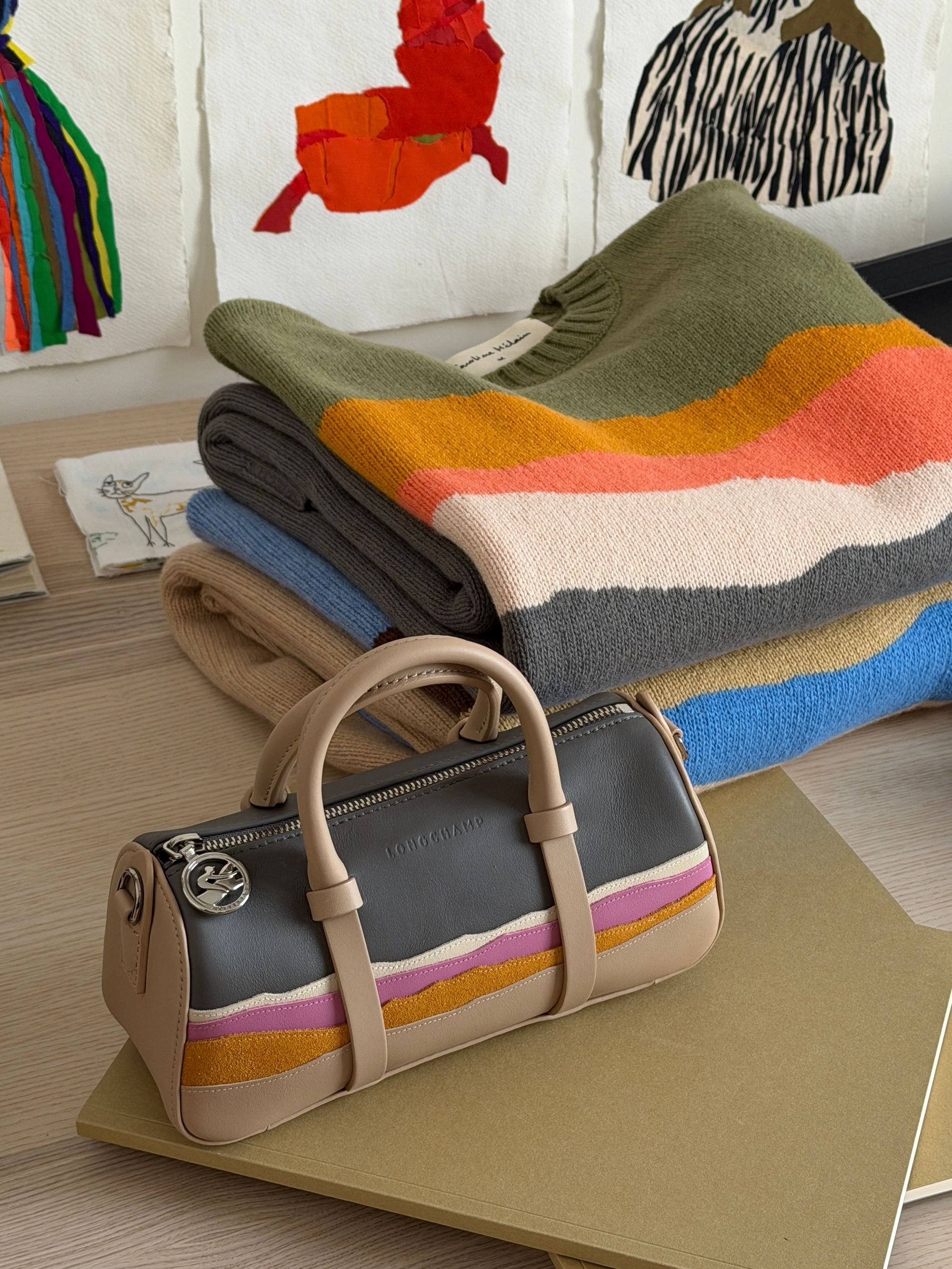
Caroline Hélain's Brussels studio desk, with the Longchamp Daylong mini bag and folded knitwear from her collaboration displayed.
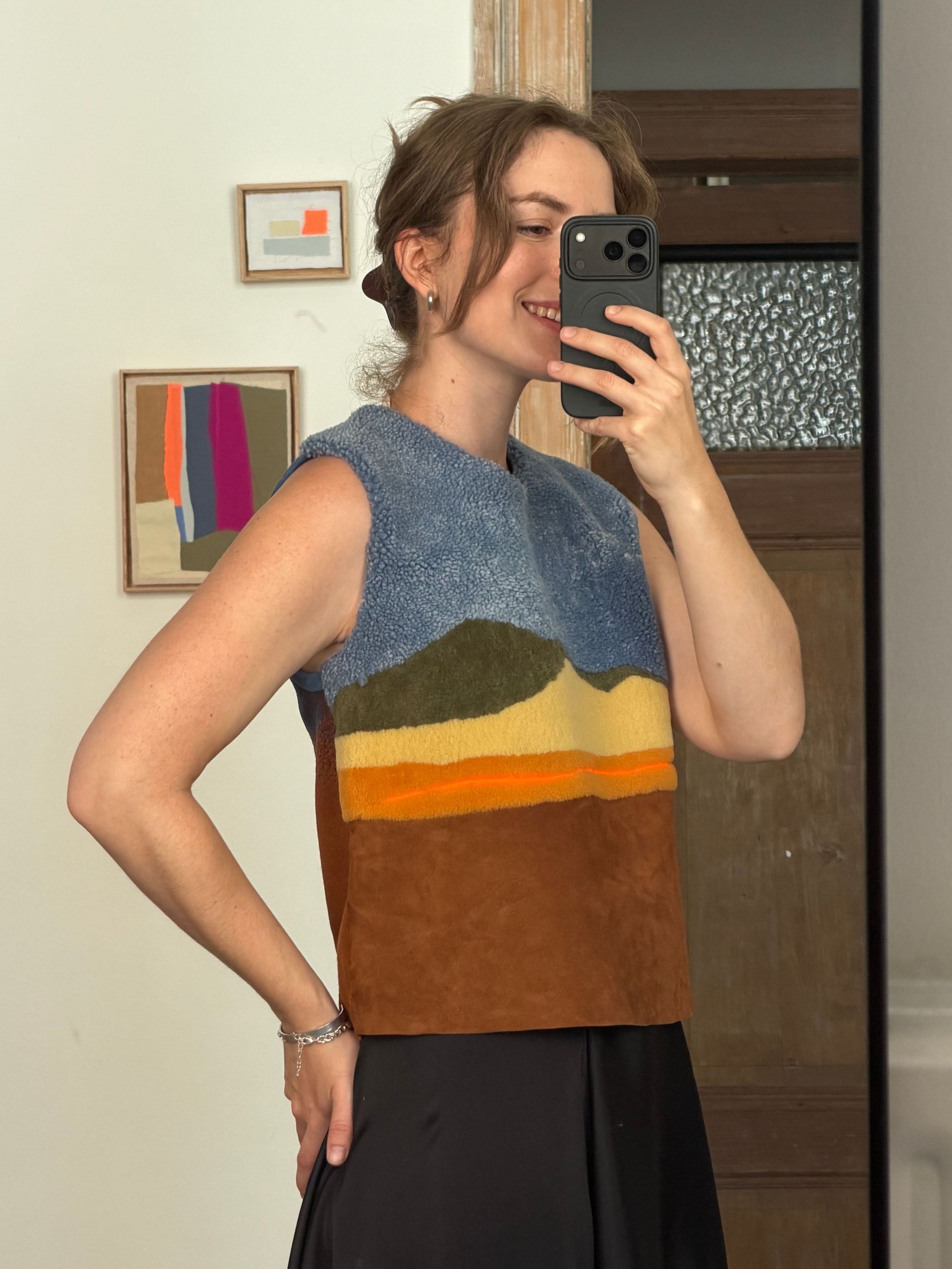
Editor Josefin Forsberg wearing the sleeveless calf leather and bouclé wool top from the collection.
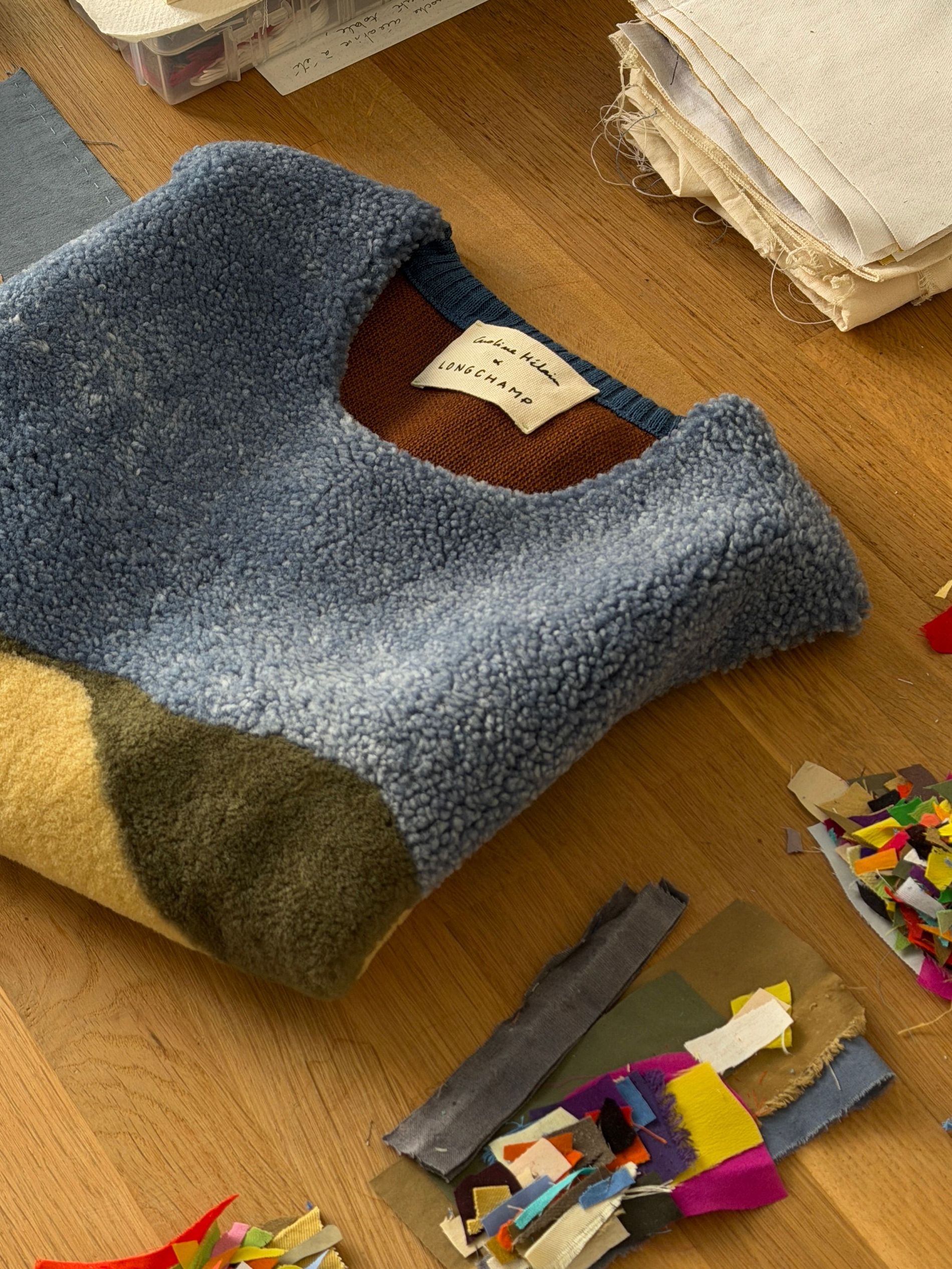
The sleeveless calf leather and bouclé wool top laid out in Hélain's Brussels studio beside spools of embroidery thread and offcuts from her fabric archive.
She was already settled in Belgium by the time her practice found its current form. She trained first as an illustrator, drawing constantly, before trading her pen for a needle and thread about a decade ago. "The line of my pen has been replaced by a needle," she tells me, "and I started painting with it." Next, Hélain picks up her scissors, the tool she reaches for most alongside her needle. "My scissors are my life," she says. "They're only used for textiles, and I hide them every time I leave the atelier." She is both teacher and student now, running her own workshops in embroidery and sewing, in her studio and at cultural institutions, while still taking classes herself: one in bookbinding, another in lace, tapestry, and weave, split between two academies in Brussels.
Much of what ends up in her landscapes starts on the water, not in the studio. Hélain sails often, and keeps her materials aboard: "Sometimes when we are at anchor, I take my materials, and I can work from real life," she says. Her own coastline, the one she returns to first, is Normandy: white chalk cliffs from her childhood, tides that never stop moving, light that shifts by the hour. The work evokes an aspect of American artist Georgia O'Keeffe's undulating landscapes, but Hélain herself pinpoints Rothko and Josef Albers as her inspirations. "At first it was more figurative," she says, "and then I took memories of the coastline, and it became abstract."
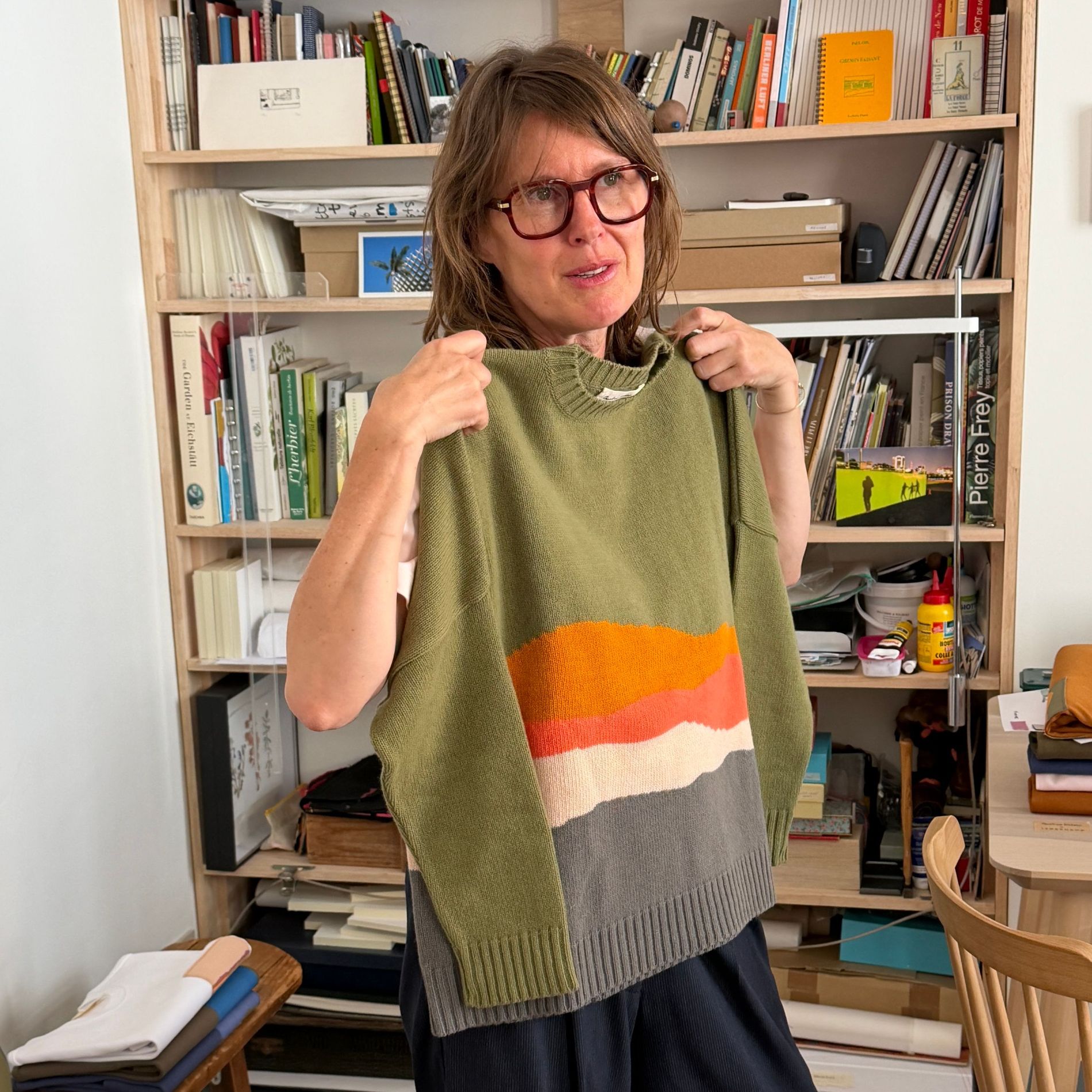
Caroline Hélain holding up the landscape-patterned sweater from her Longchamp collaboration in her Brussels studio.
"At first it was more figurative, and then I took memories of the coastline, and it became abstract."
Caroline Hélain
Having spent 10 years sailing the coast of Brittany, and the past two years, the Mediterranean, there's one landscape she still longs to explore – Stockholm's archipelago. "I visited my friends in Stockholm a while back, and we jumped on a ferry to an island in the archipelago" she says. "And when I was on this ferry with my friend, I was thinking: we really have to come back and sail around." And it is easy to see why someone like Hélain would be smitten by Sweden's cobs and islands and the natural palette of a never ending Summer's night – the dusty purples, pinks and deep blues.
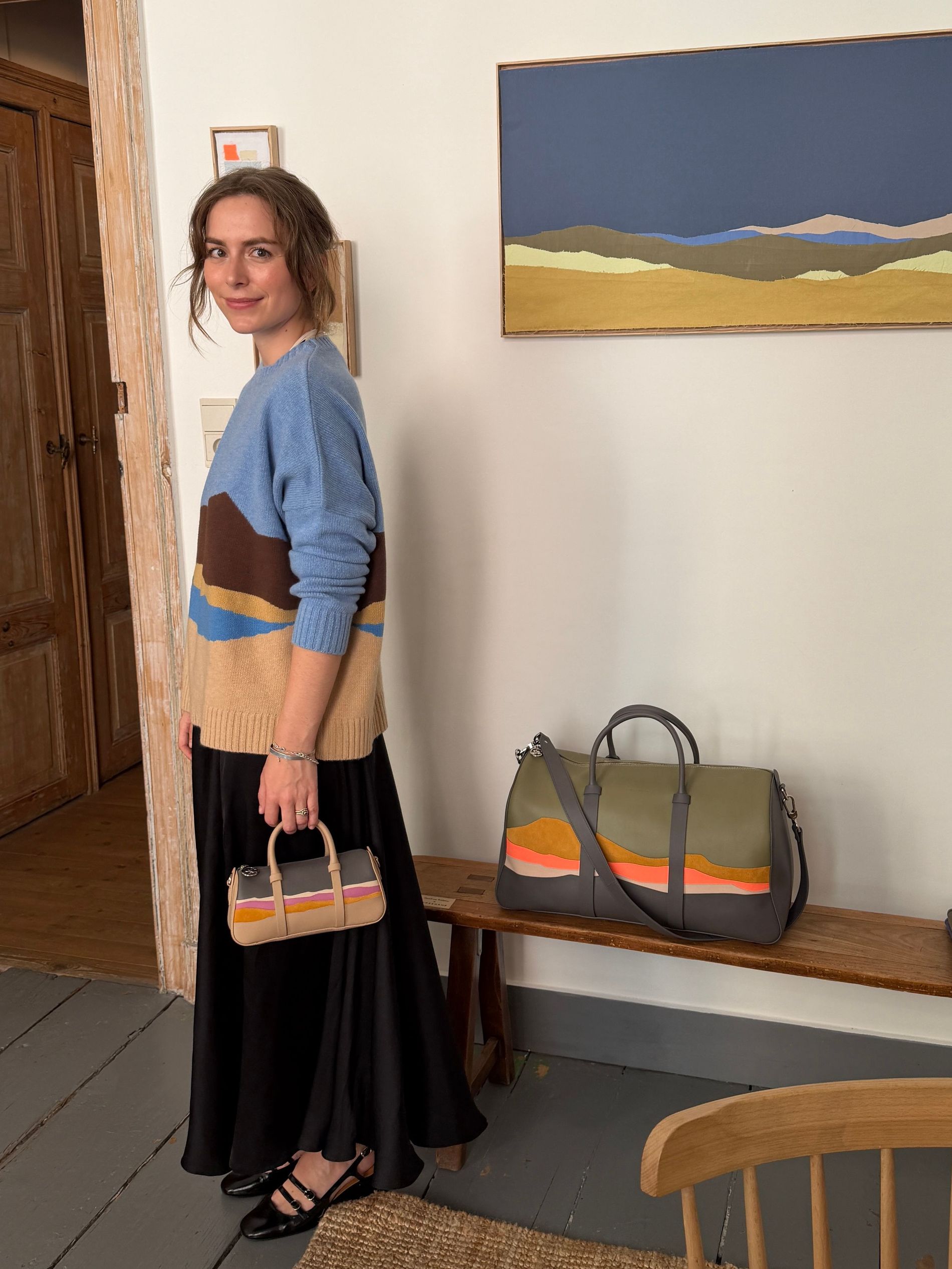
Editor Josefin Forsberg wearing the landscape-print sweater and taupe Daylong mini bag, with the olive green Daylong weekender on the bench behind her.
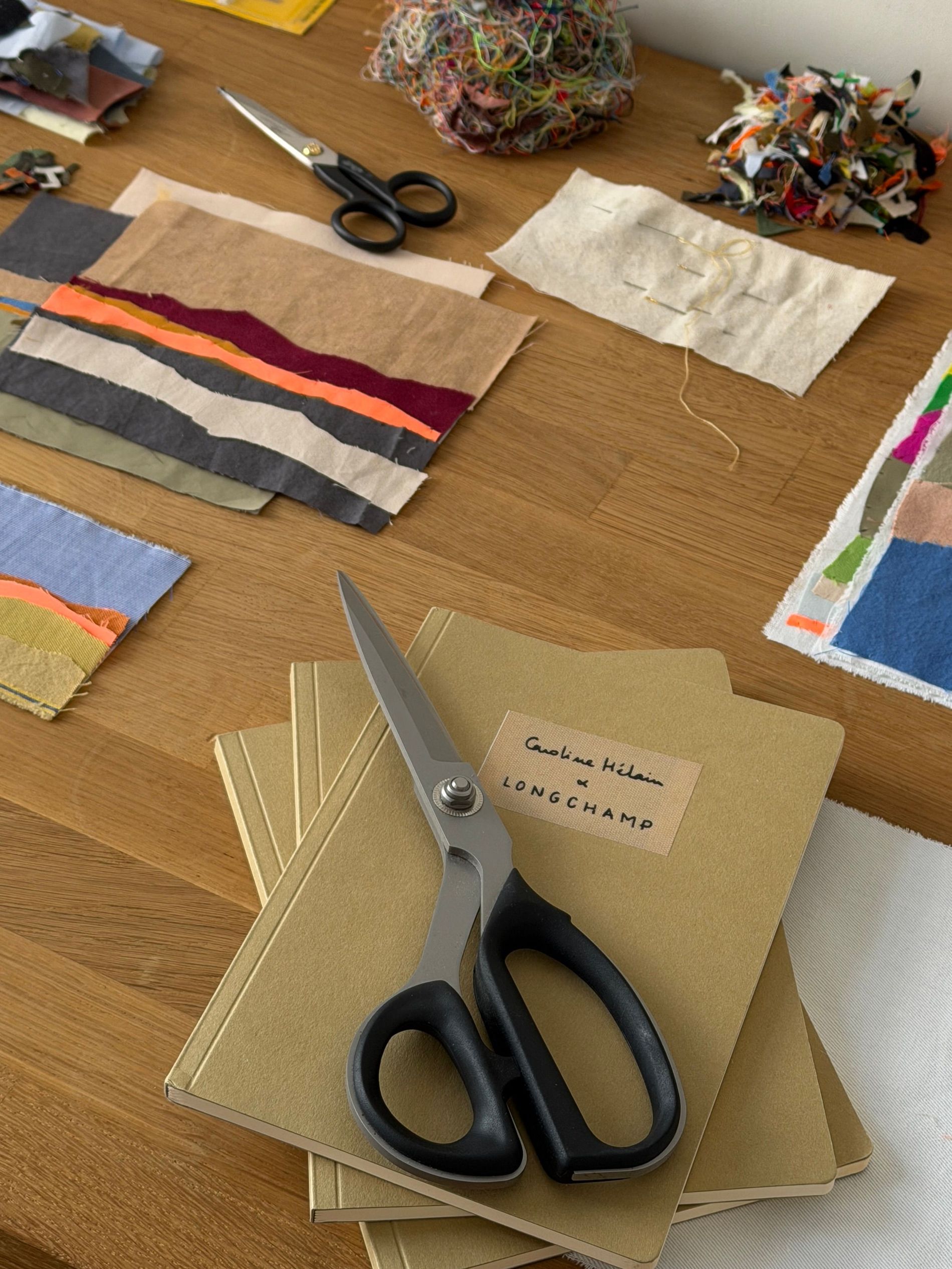
Caroline Hélain's fabric scissors resting on sketchbooks labelled, surrounded by thread offcuts and hand-cut landscape patchwork swatches.
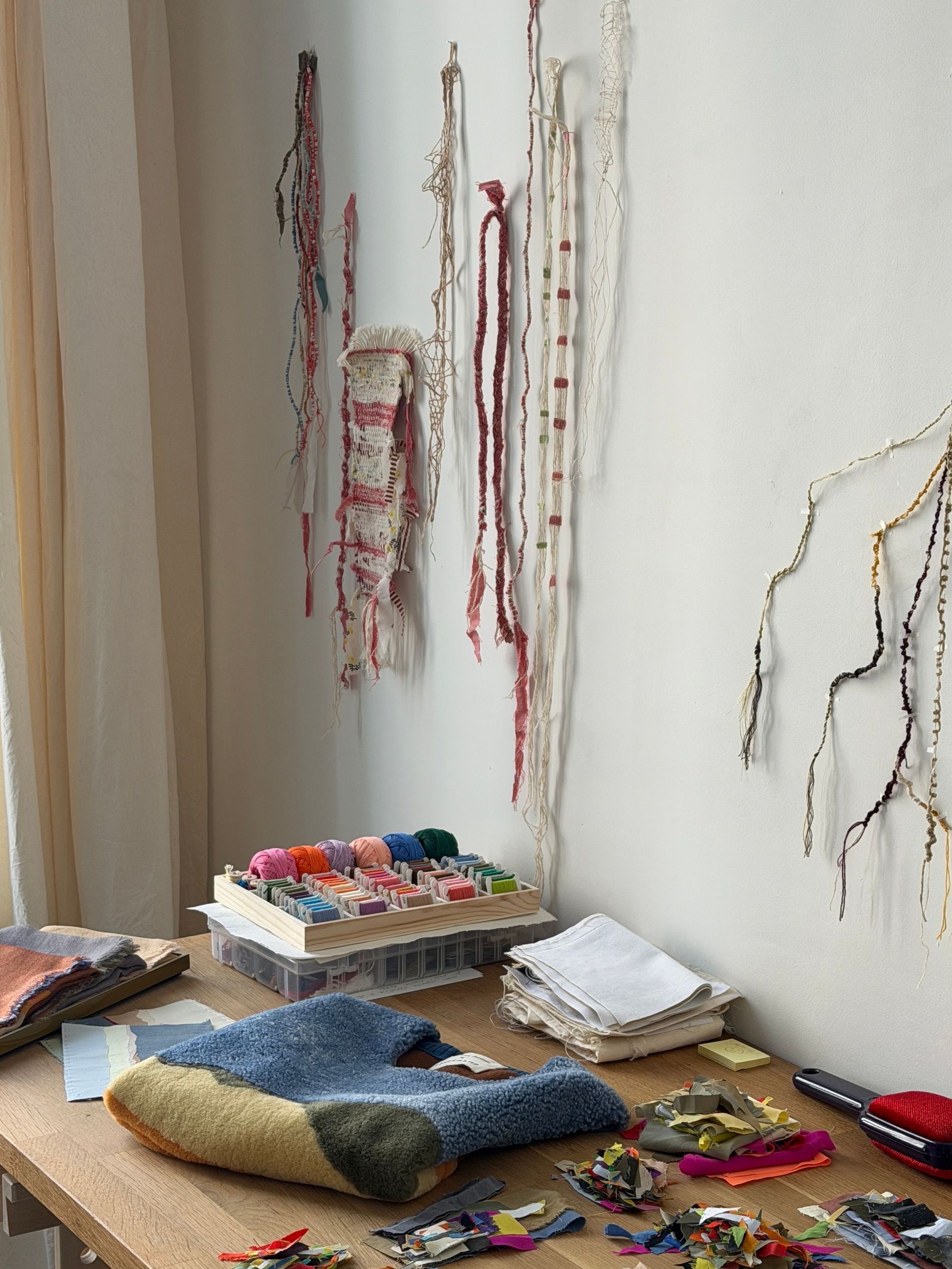
Experimental thread and fabric studies hanging on the wall of Caroline Hélain's Brussels studio, above a desk holding the sleeveless top from her Longchamp collaboration and fabric scraps sorted by colour.
For the collection, however, Longchamp provided Hélain a colour scheme: olive, thistle, caramel, and ballet pink. Working with scrap fabrics, the artist proceeded to rummage through her own archive of textiles and matched what she already owned to the colours she'd been given, sourcing only one or two shades she was missing. From there she made nine landscapes, worked exactly as she always works: alone in her studio, cutting freehand, without thinking, she says, about the fact that one of them was destined to become a bag.
The collaboration itself began as most modern relationships do, through a DM on Instagram. Sophie Delafontaine, Longchamp's creative director, had come across Hélain's landscapes on social media and wrote to ask if they could talk. Hélain, who doesn't check the app daily, didn't see it for some time. "It's like a modern fairy tale," she says of the moment. "You're posting your work on Instagram, and someone asks: can we discuss it?"
She visited Longchamp's leather workshop in Segré twice while the collection was being made, watching a process that stood in sharp contrast to her usual solitude: someone selecting leather from a full hide, deciding by touch which section would become which piece; the machines that make production possible, running alongside hands that remain, in her words, essential. "It was incredible, this adventure," she says. "I wanted to keep everything in memory." Because her cutting follows no repeating pattern, no two bags come out quite the same; the orange stripe lands slightly differently on one, the pink on another. It's the kind of variation a production line is usually built to smooth away, but here, it adds to the artistry.