
Does the magic still exist within Agnes' music? We sit down with the Swedish songbird to find out, ahead of the release of her atmospheric sixth studio album, Beautiful Madness
If you were a teenager in Europe during the late 2000s, you’ll vividly remember Agnes’s voice from the soaring harmonies and dramatic strings of 'Release Me', which hit the top 10 all over the continent. Yet following the success of that single, while Agnes remained a notable pop star in Scandinavia – it helped that she’d first broken out via a Swedish singing-competition show in 2005 – she released one more album in 2012 before going quiet for nearly a decade.
Then, in 2021, she made a triumphant return with the one-two punch of killer pop bangers 'Fingers Crossed' and '24 Hours', the first two singles off her superb fifth album, Magic Still Exists. Packed with wall-to-wall hooks and immaculate disco-inspired production, it remains one of the strongest (and most underrated) pop albums in recent memory – even if, partly due to the pandemic inhibiting her ability to promote it, the record didn’t quite get the attention it deserved. (Though that isn’t to say it wasn’t a hit in her home country: Magic Still Exists earned Agnes four Swedish Grammy nominations in 2022, and she took home the prize for composer of the year.)
Now, Agnes is back again – and finally ready to announce her sixth album, Beautiful Madness, another collection of masterful pop gems that lands on January 23.
“It’s been four years since I released my last album, but it feels like time has been flying,” the musician says over Zoom from a studio in Stockholm, where she’s been recording live versions of some of the album’s tracks. “It’s exciting, but nerve-wracking at the same time.” After the limitations imposed on her throughout her last album cycle, Agnes is keen to make performing a central part of her roll-out this time – and indeed, it’s an album that will come to full, glorious life on stage, in no small part thanks to its club-ready sound. If Magic Still Exists was, by and large, a sort of disco pop fantasia, Beautiful Madness has its roots firmly in a rich variety of dance genres, from house to techno.

Photo: Swim Club
What remains the same, however, is Agnes’s curiosity and vulnerability: on the single 'Ego', she sings about making her ego take the backseat “or this whole situation will be the death of me” over shimmering synths and a power pop beat, while on 'Balenciaga Covered Eyes', she tells the tale of a night out in Paris, crying under strobe lights and lasers behind a pair of Balenciaga sunglasses.
Yet where there was a more baroque, maximalist quality to the songwriting and production on Magic Still Exists, with Beautiful Madness, Agnes was inspired – partly by a Mark Rothko retrospective in Paris – to strip things back. “[Seeing the exhibition] was such a beautiful reminder, in the middle of recording this album, of how you can simplify things, and the impact is just as strong,” she says, noting that she tried to retain the honest emotional core of her first demos.
It all leads back to that title, Beautiful Madness, which Agnes chose specifically for its inherent contradictions: “Life is a beautiful madness, and it’s when we stop chasing perfection that the truly interesting things happen,” she says. Nobody knows how to spin pop gold out of an introspective moment on the dancefloor quite like the Swedes, after all.
Here, Agnes talks to Vogue about tightening her circle of collaborators on the record, how she achieved the record’s rawer sound, and how fashion became a central part of her storytelling.
Vogue: To go back to the beginning with this record – how soon after you finished the last album cycle did you start working on the music for this one? Are you someone who likes to have a clean break between projects, or does one tend to melt into the other?
Agnes: When I was finishing Magic Still Exists, I was already starting to think about what the next album should be about. I wasn’t necessarily trying to figure out exactly what it would be – but my thoughts were there, I felt inspired, and I began talking about it. So it was pretty seamless. I think when I made Magic Still Exists, I was at such a crossroads in my life. I was asking myself so many questions and really seeking answers. I think I needed to make something that made me feel stronger, to see the light in the tunnel. With this album, I think I understood you will never have it all figured out. Everything isn’t great all the time – and that’s okay too. If *Magic Still Exists *was painted in big, broad brushstrokes, Beautiful Madness is more about the details.
I read that you worked with a very tight-knit group of collaborators on this one. Tell me a bit more about that dynamic, and why you wanted to keep the circle smaller this time?
I think stepping into making this new album, everything felt pretty easy because I knew the people I wanted to work with on the music. I knew who I wanted to work with when it came to the clothing, the styling. I knew the creative director. I knew how I needed to do things to bring out the best of me and the people around me. I had it a lot more figured out than last time. But I also knew when I started to work on this album that I wanted to bring in a little bit more of a clubby, house sound, so I did need to find people who really live in that world too.
But I really want to work with as few people as possible, because it’s so much easier to push each other when you’re really close and you feel it’s a safe space. I want to be able to say to someone, “You can do that one more time and it’s going to be even better,” and I want them to tell me the same thing. When you’re in the same state of mind, so many things happen without you even needing to say them. I also made sure to bring in the people I’m working with for my music videos and my stylist pretty early on in the process, because I wanted them to be in the zone and start to have ideas. So when we stepped into starting to work with the visuals, they were already in that world.
You mentioned the club influence on the album. What about dance music was inspiring you, or felt like the right fit for the stories that you wanted to tell on this record?
Since I was a teenager, I’ve always been very inspired by the club, and that strange mix of being introverted and extroverted when you’re dancing at the club. I’ve also had so many experiences while I’ve been out dancing and partying that are physical and spiritual at the same time. I often think about how I can bring that into my own music. I had that in mind while I was making Magic Still Exists, which was more of a disco pop sound. But this time, I wanted to go one level further down in the basement, in a way.
You’ve mentioned wanting the sound to feel rawer and less polished, and how you were inspired by Mark Rothko on that front. How did you channel that energy into the music?
It happened pretty organically. I was in Paris and saw an exhibition of his work at the Fondation Louis Vuitton, and it was so powerful. It was such a beautiful reminder, in the middle of recording this album, of how you can simplify things, and the impact is just as strong. We started talking about that a lot in the studio. Magic Still Exists was very maximalist, with so many layers – which was definitely the right thing to do for that album – but with this one, we wanted to use fewer elements and give every element more space to breathe. In terms of it being less polished… sometimes, when you go into the studio and you make the first demo of a song, there’s a nerve to it that is so easy to lose along the way. We really wanted to try and keep that nerve, and also the self-confidence of saying, You don’t have to put everything in there. What we have is enough.
That relates to one of the themes of the album, which is about letting go of control – whether in love, or creativity, or just on the dance floor. Is that something you’ve struggled with as an artist? The urge to control every detail versus letting things go and seeing what happens?
I think that’s my life lesson, honestly. It’s a powerful thing. You have to have a clear vision of where you want to go and what you want to do, but then – especially because I love to work with other people – you have to leave space for others to bring in their magic. You have to sketch out the picture, but you can’t finish the painting. And I think that’s a constant balance for me – showing people where to go, but not being overly controlling in the process. I think it relates to what I was saying about knowing the people you work with really well, and not having to spell everything out.
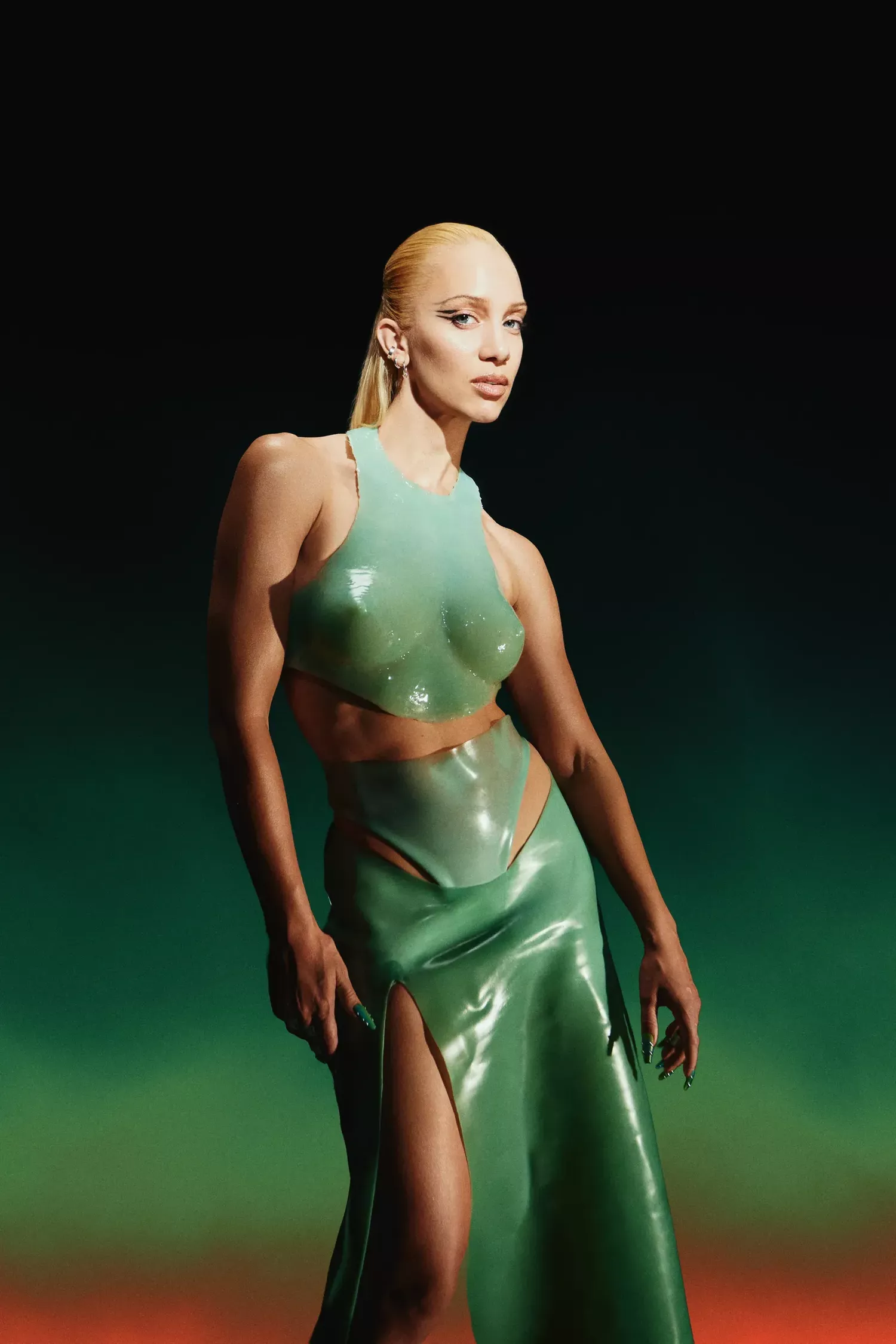
Photo: Swim Club
Tell me the story behind the visual world you’re building around the album – and what you’re channeling on the fashion front, too? It sounds like you had a fairly clear vision from the beginning.
I think with Magic Still Exists, I had this idea of wanting strong silhouettes – especially on the album cover, so it felt memorable. It was also a bit of an armour for me, and I felt very strongly going into this album that I had to get rid of that armour. I wanted to show more skin, I wanted to have a touch of something sportier, so my stylist and I started playing around with a lot of latex and silicone and fabrics that felt like a second skin. We wanted them in beautiful colours, but also a bit disgusting—beautiful and weird at the same time. For me, Beautiful Madness is so much about those opposites. You can be strong and you can be vulnerable, you can be beautiful and ugly, you can be loving and selfish all at the same time. And I think we played with that when it came to the styling and also the choreography.
How far away is the style of Agnes the pop star from Agnes Carlsson the person?
I think with Magic Still Exists, I felt more like I was stepping into an alter ego. I played with that a lot, and I also really needed that at the time. But with this album, I feel like it’s a more extroverted version, a glossier version, a weirder version of myself. I felt really strongly about presenting something a bit closer to who I am in everyday life – but still extra. [Laughs.] So yeah, I think now we’re somewhere between the alter ego and me.
That's a nice place to be. Obviously, you have a big following in Sweden and a cult following internationally among pop fans. I remember hearing Magic Still Exists and thinking it deserved to be huge – even though it definitely cultivated a devoted fanbase, it remained somewhat niche. What are your ambitions in terms of growing that fanbase with this record, or do you feel like it’s at the right sweet spot for you?
I think because we released Magic Still Exists during the pandemic, it was frustrating. I really wanted to go out there and meet the people who are listening to my music, but that wasn’t possible. So I think for me now, my main focus is to go out and perform live and meet the people who are actually listening to the songs. And of course, I want my music to go outside of Sweden, but I think I’ve always had this kind of indie idea of who I am as an artist. It doesn’t matter where my fans are. It was such a beautiful and powerful thing for me, releasing Magic Still Exists and seeing how people really felt it and connected with it and understood it. Releasing this new music, I hope it grows bigger, because of course I want people to really connect with the universe I’m trying to create. But I’m just going to keep doing what I’m doing – and try and perform a lot more this time around, now that I can.
This interview was originally featured on Vogue.com