
The celebrated designer leaves an indelible mark on the world of international fashion
Valentino Garavani, the Roman couturier who launched his label in 1960 and found worldwide fame dressing European royals, American first ladies, and stars of the day, has died at his home in Rome. He was 93.
With his exacting pattern-making, signature hue of poppy red, and eye for feminine details like bows, ruffles, lace, and embroideries, Valentino was one of the key architects of late 20th century glamour. Val’s Gals, as his coterie was often called, included Elizabeth Taylor, Audrey Hepburn, and Sophia Loren. Jackie Kennedy wore a white gown of Valentino’s creation for her wedding to Aristotle Onassis, and decades later the designer interpreted a mint green gown he had made for the former first lady in 1967 for Jennifer Lopez’s appearance at the 2003 Oscars. In 2001 Julia Roberts accepted her Best Actress award for Erin Brokovich in a vintage black and white Valentino gown.
In 2009, The designer was the subject of the Matt Tyrnauer-directed documentary, Valentino: The Last Emperor, which followed the designer, his career-long business partner Giancarlo Giammetti, and his entourage in the two years leading up to his retirement. In the film, Valentino tells a reporter: “I know what women want, they want to be beautiful,” a 10-word summation of the aesthetic that had turned him into a multimillionaire.
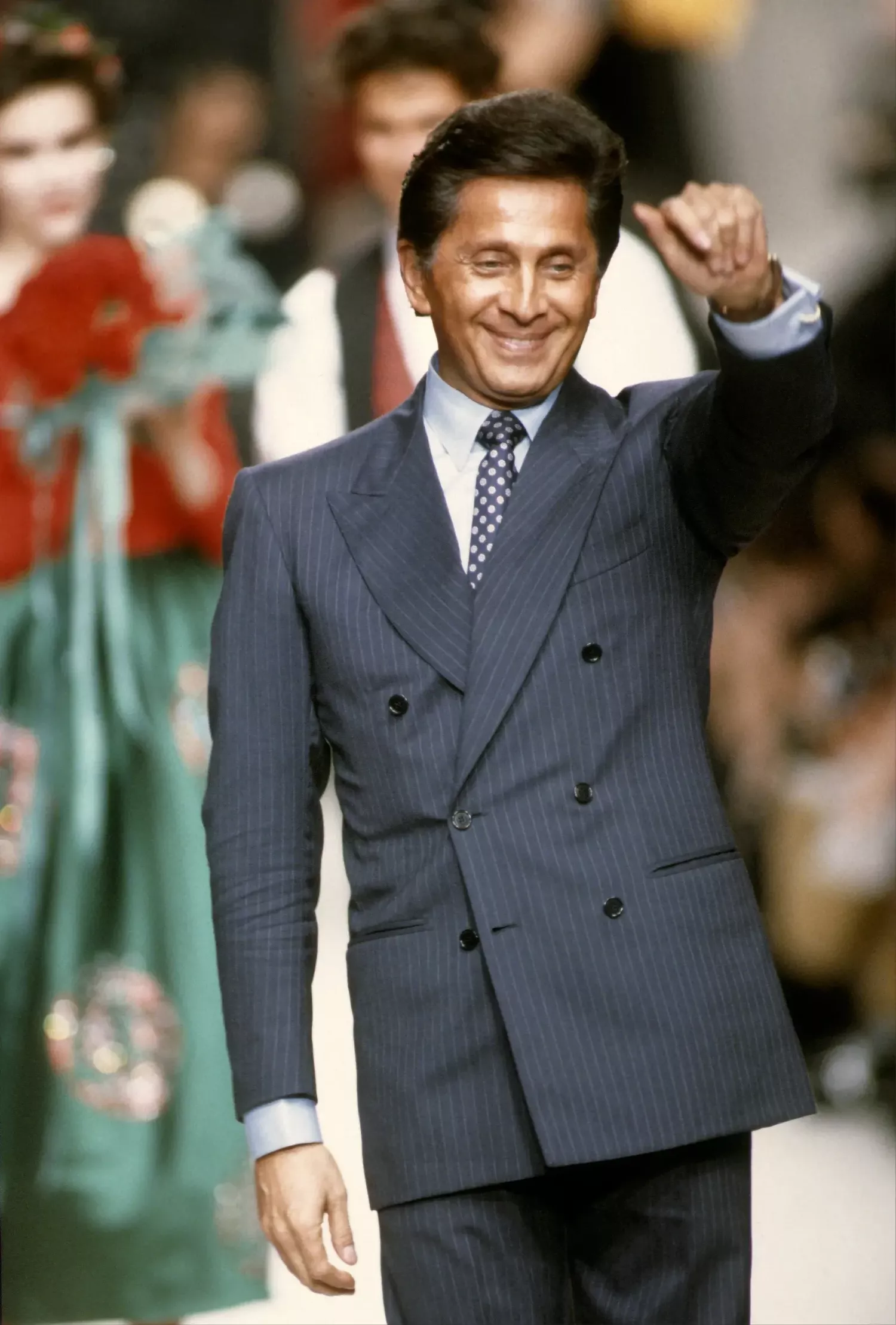
Photo: Getty
In the years after his retirement in 2008, which was feted with a three-day extravaganza in Rome, Valentino hardly faded from public view. He could be found many seasons sitting in the front row of Paris’s Hotel de Rothschild, taking in the latest collection from creative directors Pierpaolo Piccioli and Maria Grazia Chiuri, the latter of whom decamped for Christian Dior in 2016. Valentino was so moved by Piccioli’s haute couture collection for fall 2018 that he stood for an ovation, tears rolling down his tanned cheeks.
When he wasn’t cheering on the designers who inherited his label, Garavani could often be seen on Instagram, hosting glamorous parties at his French estate Wideville or on his yacht TM Blue One, rarely without his brood of pugs in tow.
Valentino Clemente Ludovico Garavani was born in Voghera, Italy, on May 11, 1932. He decided on design as his métier early on and enrolled at the Accademia dell’Arte in Milan where he studied fashion and French. Pursuing his ambition, at 17 Garavani moved to Paris to attend the École des Beaux Arts and the Chambre Syndicale de la Couture Parisienne. Post-studies, he assisted Jean Dessés, a Greek designer known for his pleated evening dresses, and Guy Laroche, a Frenchman with a sportier aesthetic.
After a year spent working alongside the noted beauty Princess Irene Galitzine, who popularized elegant evening pajamas, Garavani set out on his own with the backing of his father and a family friend, establishing his maison, circa 1959, on Rome’s Via Condotti. “It was une maison de couture,” explained Giammetti – who met Garavani soon after – in an interview with Vanity Fair. “I say it in French because it was very much on the line of what he had seen in Paris… Everything was very grand already. Models flew from Paris for his first show. Italian fashion was very limited at the time. There were a few good designers, but just a few.”
With Giammetti at his side, Valentino became one of the very best, despite the fact that within a year he was facing bankruptcy. He blamed his “champagne tastes,” and the pair soon vacated Via Condotti and moved to a smaller space in a 16th-century palazzo on the Via Gregoriana.
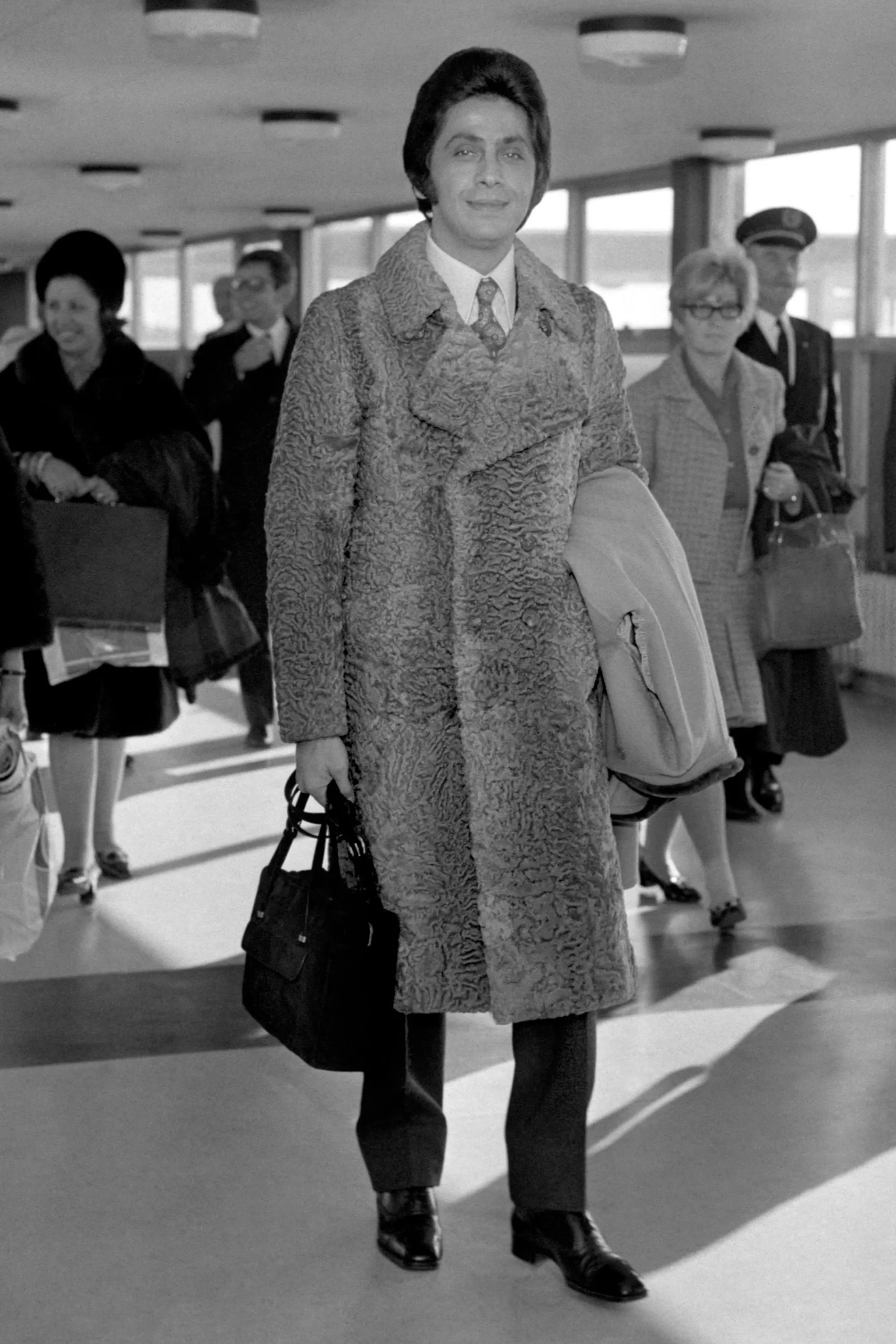
Valentino Garavani, 1970. Photo: Getty
The press, initially interested in Valentino as a budding talent and handsome new face, soon had more incentive to pay attention to this young designer: his celebrity pull. In 1961, the violet-eyed Elizabeth Taylor, in town to shoot Cleopatra, chose a white haute couture column by Valentino to wear to the premiere of Spartacus.
The designer’s All White couture collection of 1968 is the one that set him solidly in the firmature of Italian design. Vogue declared it “the talk of Europe,” and waxed lyrical about “the cleanliness and distinction of his crisp whites, his lacy whites, his soft and creamy whites, all shown together white on white. And all triumphs for the thirty-five-year-old designer who, pouring out all this beauty, romance, and perfection, has become the idol of the young, a new symbol of modern luxury.” Some of these marvels were photographed by the magazine in Cy Twombly’s Roman apartment on Marisa Berenson, who, as a granddaughter of Elsa Schiaparelli, qualified as fashion royalty.
Despite the white collection’s historical importance, the designer will forever be associated with the colour red, and not just any shade, but a sparkling crisp Valentino red that speaks of Italy, passion, religion, lust, and love.
“Everything,” he once said, “is made to attract, seduce, entrance.” As alluring a woman wearing Valentino might be, however, she was above all and unmistakably a lady.
There is a certain polish and formality to Valentino’s work that speaks to an earlier age of glamour and the beginnings of the jet set, which is now a thing of the past. The dream of the good life never gets old, however, and the lure of the brand was, in part, its link to the lives of “the rich and famous,” an A-list crowd of which Valentino was a member. It should be noted that formality is not synonymous with modesty; evening dresses with lingerie touches were a part of Garavani’s repertoire, and he appreciated a lovely decolletage. Also abs: dresses with tastefully placed cut-outs were another specialty that appealed to the fit and fabulous.
Casual was always a relative term in Valentino’s world—the designer even looked put-together in that famous paparazzi pic taken in Capri in 1970 with a barefoot Jackie O. His signature look was a perfect coif, a rich tan, and a suit. Pierpaolo Piccioli, who joined the house in 2008 (and who dared to wear flip-flops to the office) remembers that the air conditioning was on full blast in the offices all summer so that the staff could wear suits. “I was happy that I arrived there when I was all grown up,” Piccioli told Vogue in 2019. “Valentino was formal – very, very formal. There was a ritual, and I liked that.”
Although Valentino was producing ready-to-wear from the category’s earliest days in the 1960s it was elevated rather than laid-back. “If anyone can approximate haute couture detailing in ready-to-wear, it is he, Vogue critic Sarah Mower noted decades on.
Though Garavani has expressed his dislike for 1980s fashions, Vogue wrote that the business soared at the time; reporting that “in 1986, Valentino was Italy’s top fashion exporter, shipping some $385 million that year.” If the Valentino aesthetic was the polar opposite of grunge that dominated so much of the ’90s, it was extremely relevant to the celebrity culture that started to take off in that decade. This shift benefited “Va-Va” greatly, and he racked up major red-carpet credits.
Like the celebrities he dressed, Garavani was himself a star. As Piccioli once put it: “Valentino was the brand himself.” And the designer lived the life he designed for. Long after his retirement, Garavani remained an arbiter of taste and decorum and a paradigm of success. He lived his life in pursuit of beauty. “I loved working with him,” Piccioli told Vogue. “I loved to hear him talking about his dreams of a dress drawn with one line.” Long may his dreams live.