
At this year's Nobel Gala, two visionary Stockholm-based creatives were tapped to produce the musical and visual experience. Working in tandem, composer Jacob Mühlrad and visual artist Alexander Wessely set the tone for the prestigious event. Below, they break down the four-act masterpiece
The 2025 Nobel Gala at Stockholm City Hall was conceived around the theme of “bridging worlds” – a vision placed in the hands of two Stockholm-based yet globally acclaimed creatives: 34-year-old composer Jacob Mühlrad and 36-year-old visual artist Alexander Wessely. Long-time collaborators with nearly a decade of shared work behind them, the pair approached the evening as a single, interconnected artwork, where music and light moved in dialogue rather than in parallel.
For Wessely, the starting point was the building itself. Stockholm City Hall, he notes, is both iconic and fragile – a historical space that demands precision, restraint and deep respect. He treated it as “a living sculpture,” a place where tradition and innovation could meet without cancelling one another out. “The architecture, the history and the contemporary moment became materials,” he says. “Light was the element that allowed these worlds to connect. It became a spatial journey rather than a decoration – something that lets the room breathe in a new way while still honouring its legacy.” His intention was not to impose an emotion but to create what he calls a “quiet clarity,” an atmosphere spacious enough for every guest to find their own response.
/Wessely_Issue_25_7_7da2e96dae/Wessely_Issue_25_7_7da2e96dae.jpg)
Photo: Felix Odell
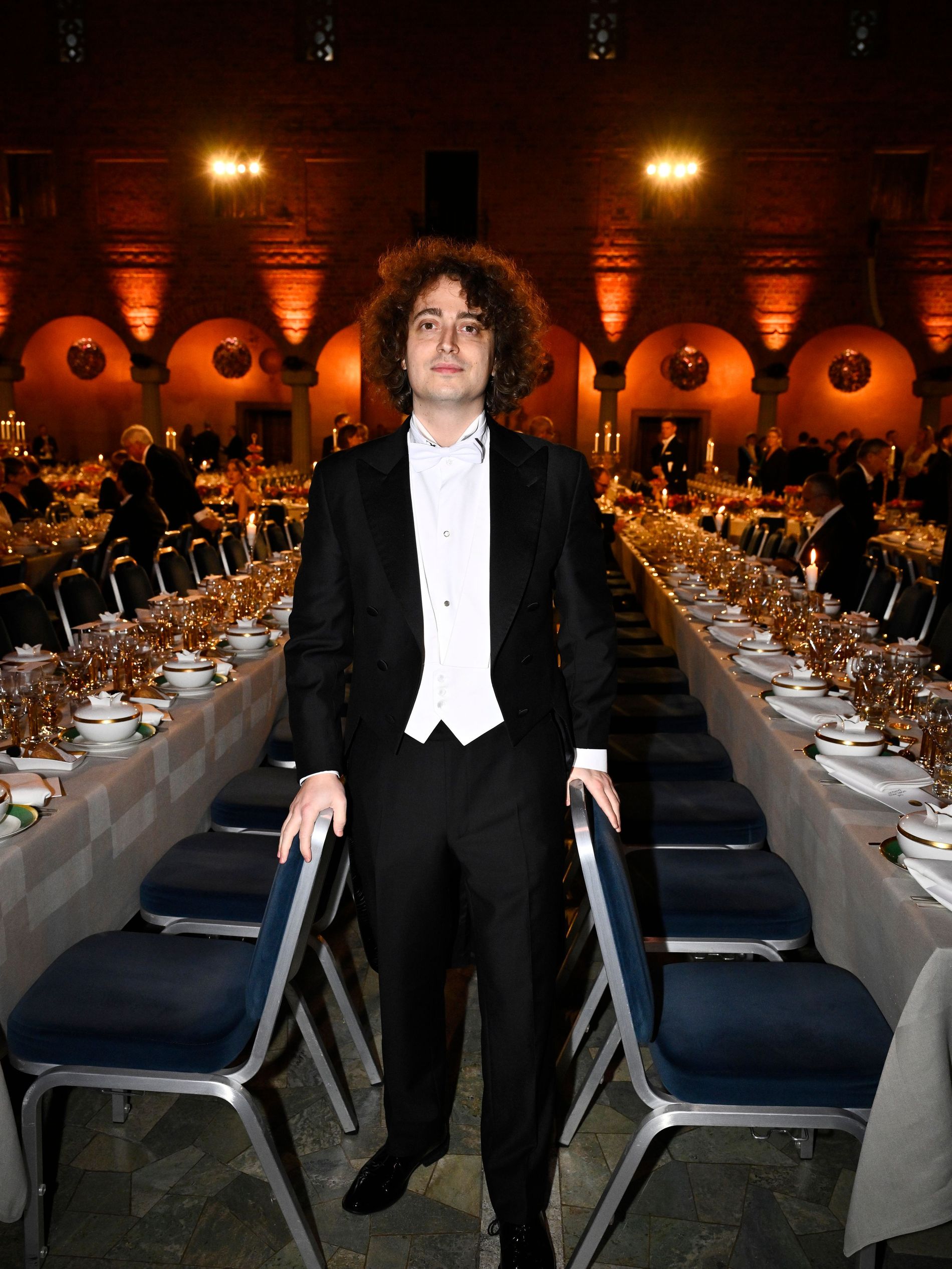
Photo: TT
Mühlrad, meanwhile, shaped what he describes as the “temporal structure” of the night – the emotional spine of the experience. His compositions, ranging from sacred song to quantum-physics-inspired experimentation, provided the narrative flow that guided Wessely’s visual world. “Alex is amazing,” Mühlrad says. “We’ve worked together for almost 10 years. He’s one of the few visual artists who truly understands my music.” Wessely echoes that sentiment: “It is less collaboration in the traditional sense and more like building one shared atmosphere. The music affects how the light moves, and the light reshapes how the music is felt.”
Their combined vision unfolded across a series of distinct acts – a progression from the intimate to the monumental, expanding from grounded arrival to weightless release. Below, we break down the four aesthetic acts as they were seen and heard at the 2025 Nobel Gala.
Below, the duo break down the four aesthetic acts as seen and heard at the Nobel Gala 2025.
Act 1
The opening act, as Mühlrad describes it, explored the universal and the spiritual. It began with a sacred song from his more religious youth, performed by a tenor singing in Hebrew – a direct homage to the rabbis he listened to in his childhood synagogue. From there, he threaded in a newer composition: 'Deer', written for robotic cello and symphony orchestra. “The two seemed to lean into each other naturally, so I put them in a loop,” he notes. The act then expanded into a clarinet concerto inspired by the Turkish Sufi tradition. In his research, Mühlrad became fascinated by the ancient Maqam system, traditionally accompanying the Sufi dance. “It’s a musical tradition that transcends religious boundaries,” he says. “I think it’s a beautiful way to show what we share.”
For Wessely, this first act was an arrival – “a grounding of the room and a quiet pulse that prepares the mind.” “Jacob shaped the temporal structure, the emotional spine,” he explains. “I shaped the spatial one. The music affects how the light moves, and the light reshapes how the music is felt.”
Act 2
Mühlrad's transcendental first act transitioned seamlessly into a second that felt more secular, anchored by an 11th-century love hymn originally written for choir and later expanded for string orchestra. The piece is among his earliest compositions and carries a personal resonance: “I sang it myself in the synagogue when I was six or seven,” he recalls.
As the music opened up, so did the space. Wessely’s visuals revealed the architecture’s underlying “structure and rhythm,” treating Stockholm City Hall as a living organism where tradition and innovation could meet. “It became a spatial journey rather than a decoration,” he says.
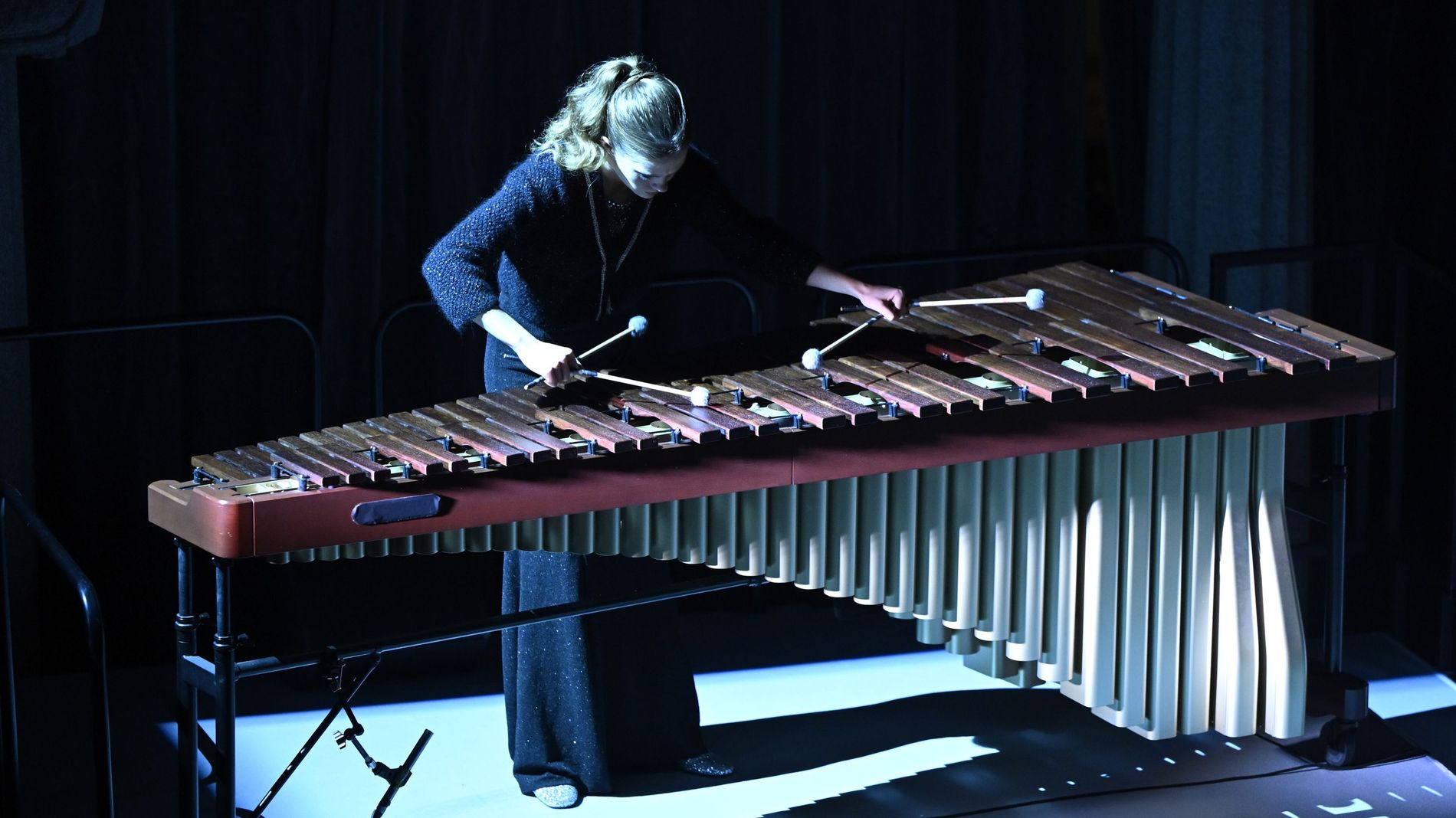
Photo: TT
Act 3
In this act, Mühlrad debuted his latest composition, 'Superposition', inspired by the quantum physics experiment of the same name, alongside the visuals of Wessley, which he referred to as "the release." The piece used rapid. overlapping notes to create a musical interference effect, realised by Mühlrad bringing in leading marimba soloist Adelaide Ferrier. “I’ve never written a solo for marimba before,” he says. “I wanted to bring something entirely new to the banquet.”
The performance invited a profound dialogue between two seemingly disparate fields. "I’m very interested in religion, but also in science," Mühlrad explains. "They go hand in hand in a way – at some point, science becomes very philosophical, and I think creativity plays a huge role in understanding the world.
It was within this act that the night’s headline moment appeared: Mühlrad’s reinterpretation of Swedish House Mafia’s 'One'. "I thought it would be a nice contrast to everything else," he muses. "It had a good placement next to the marimba solo." But how had he transformed the club anthem? "In a way, it’s a new piece, but what’s kept is the DNA of the song – the falling melody, which is brilliant. Then there’s the rhythmical DNA, and the two modulate, becoming almost cinematic, like a movie score."
Act 4
This flowed seamlessly into the fourth and final act. "Act four is more like a movie score," Mühlrad says, referencing Bränn alla mina brev (Burn All of My Letters). "In the first three acts, the music is intense and front and centre. But as they bring out the dessert, it shifts, becoming part of the background of the evening. In that sense, it’s quite a contrast."